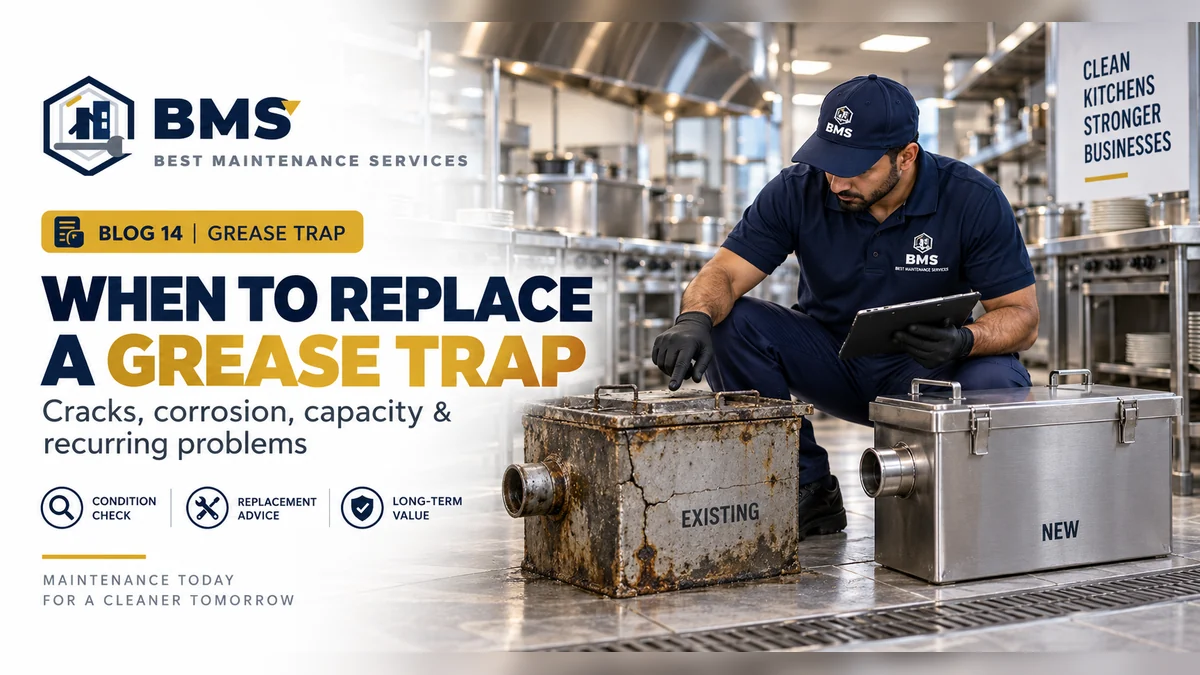
Repeated grease trap problems are not always solved by another cleaning. Learn when cracks, corrosion, capacity, access or recurring failures can justify replacement in a Dubai commercial…
Grease traps are serviceable assets, not disposable items that should be replaced at the first sign of dirt or odor. Many problems improve with correct cleaning, maintenance or drainage work. Replacement becomes the better decision when the unit itself is structurally damaged, unsuitable for current demand, impossible to maintain properly or repeatedly involved in failures that cannot be corrected economically.
The objective of a grease trap replacement in Dubai should be to remove a known limitation, not simply exchange an old box for a new one. Before ordering a replacement, identify whether the problem is inside the trap, in its connections, in downstream drainage, or in the way the kitchen is using and maintaining the system.
Sign 1: Structural Cracks or Persistent Leakage
A structural crack in the body or chamber can allow wastewater or grease to escape and may worsen over time. Temporary sealing may not be appropriate where the material, location or extent of damage makes a durable repair uncertain. Repeated leakage after attempted repair is a strong reason to reassess the whole unit.
First confirm that the leak is genuinely from the trap body rather than a loose connection, damaged gasket, lid seal or nearby pipe. The repair-versus-replace decision depends on the failed component.
Sign 2: Significant Corrosion or Material Deterioration
Metal components can corrode, while other materials may crack, deform or deteriorate depending on age, installation and chemical exposure. Surface discoloration alone is not the same as structural failure, but thinning walls, damaged fittings or compromised connections should be treated seriously.
If corrosion affects several parts of an older unit, repeated component repairs can become more expensive and disruptive than planned replacement.
Sign 3: The Kitchen Has Outgrown the Existing Capacity
A trap selected for the original kitchen may be undersized after a restaurant adds seats, extends operating hours, changes menu, installs more sinks or increases production. Frequent servicing, high retained levels and overflow under normal operation can indicate that capacity should be reviewed.
Do not assume the answer is simply a physically larger trap. Recalculate the requirement from current fixtures, flow, FOG load and available service space. The BMS installation guide provides additional planning context.
Sign 4: Internal Components No Longer Support Proper Flow
Damaged or missing baffles, deteriorated inlet/outlet arrangements or poorly fitting internal components can reduce grease separation and create unstable flow. If compatible replacement parts are available and the main body is sound, repair may make sense. If the internal design is obsolete or several components are failing, replacement can be more reliable.
Any repair should leave the unit maintainable and should not create a configuration that is difficult to inspect later.
Sign 5: Access Is So Poor That Proper Maintenance Is Repeatedly Compromised
A grease trap hidden under fixed joinery or equipment may technically exist but be impossible to service effectively. If the kitchen repeatedly postpones maintenance because covers cannot be opened or waste cannot be removed safely, the installation is creating an operational risk.
Replacement or relocation can sometimes solve the maintenance problem better than continuing with an inaccessible unit. Review new access before removing the old trap so the same mistake is not reproduced.
Sign 6: Recurring Problems Continue After Proper Cleaning
Repeated odor, overflow or blockage does not automatically prove the trap needs replacement. First separate trap condition from downstream drain condition. A clean, structurally sound trap can still back up when the outlet pipe is heavily restricted.
Where drain buildup is suspected, coordinate professional drain cleaning. If the problem continues after the pipework and maintenance interval are corrected, replacement assessment becomes more meaningful.
Repair or Replace? A Practical Comparison
| Situation | Likely route |
|---|---|
| Minor replaceable seal/cover component | Repair may be reasonable. |
| Single connection fault | Repair/reconnect after confirming unit condition. |
| Structural crack or repeated body leak | Replacement often deserves consideration. |
| Multiple corroded components | Compare full repair cost with replacement. |
| Kitchen demand has materially increased | Review sizing before replacement. |
| Downstream drain blocked | Clean/inspect drain; do not blame trap automatically. |
| Access prevents proper servicing | Consider redesign or relocation. |
What to Review Before Selecting the Replacement
- Current kitchen type and operating hours.
- All fixtures connected to the grease line.
- Peak wastewater flow and FOG load.
- Available dimensions and access route.
- Inlet/outlet levels and downstream pipe condition.
- Cleaning method and future service access.
- Any planned kitchen expansion or equipment changes.
Plan Replacement to Minimize Kitchen Downtime
A commercial kitchen needs a clear shutdown and reinstatement plan. Confirm the isolation required, removal route, floor or cabinet protection, new connection work, cure or test time where relevant, and how normal operation will be confirmed before handover.
Where the replacement is part of a renovation or kitchen upgrade, coordinate it with the wider technical programme rather than completing finished floors or equipment positioning first.
Replacement Should Solve the Root Problem
A new grease trap is only an improvement if the cause of the old system’s failure is understood. If the old unit was undersized, select against current demand. If access was poor, redesign access. If downstream grease buildup caused backups, clean the drain as part of the work. If maintenance records were weak, start a documented schedule at handover.
BMS can assess supply, installation and replacement through its grease trap service. Share photographs, unit dimensions or model information, recent service history and the specific recurring problem so the decision is based on evidence rather than age alone.
Site Information That Improves the Assessment
For grease trap replacement Dubai, a useful enquiry includes the exact kitchen location, business type, operating hours, photographs of the trap and connected sink area, the last known service date, and a short description of any overflow, odor or downstream blockage. If drawings, model information or previous service records exist, include them. These details help separate a capacity, installation, maintenance and drainage problem before unnecessary work is proposed.
For an operating kitchen, also explain when the problem is worst: during opening preparation, peak lunch or dinner service, pot washing, or after a particular sink is used. Timing can reveal whether the system is being overwhelmed by peak flow, whether one connection is creating the issue, or whether a downstream restriction is affecting several fixtures.
Commercial Kitchen Decision and Handover Standard
A professional result should be understandable after the technician leaves. The handover should identify what was inspected, what condition was found, what work was completed, any limits on the inspection, defects that remain, and the next recommended action. Where a new unit or modification is proposed, the customer should be able to see how the recommendation relates to current kitchen demand, available space and future maintenance access.
This record is especially important for landlords, facility managers and multi-site restaurant operators. It reduces repeated diagnosis, gives the next contractor useful history and helps management see whether the same failure is returning despite routine servicing.
Avoid Solving the Wrong Problem
Grease-trap faults and commercial drain faults often appear together. An interceptor can be maintained correctly while the outlet pipe remains grease-lined, or a drain can be cleaned while an undersized or damaged trap continues to overload it. The most cost-effective approach is to identify which part of the system is responsible before repeating the same service.
BMS keeps grease-trap sizing, supply, installation and replacement separate from drain cleaning and wider commercial-kitchen maintenance. That structure makes quotations clearer and gives customers a direct route to the service that actually owns the problem.
Questions to Confirm Before Approving the Work
Before approving work related to grease trap replacement Dubai, confirm the symptom or operational objective, what has already been tried, the exact scope included, any exclusions, the access or shutdown required, and how completion will be verified. This avoids a common maintenance problem where the customer and contractor use the same service name but expect different work.
For corrective work, ask what evidence supports the recommended action and what would change the recommendation. For planned maintenance, ask what condition will be checked at the next visit and how the interval should be adjusted if the system is loading faster or slower than expected. These questions turn the service from a one-off transaction into a controlled maintenance decision.
Property and Operations Context Matters
The same issue described in When Should a Grease Trap Be Replaced? Cracks, Corrosion, Capacity & Recurring Problems can have different consequences in a villa, apartment tower, restaurant, hotel or managed commercial site. Access permissions, occupied areas, service hours, equipment shutdown, noise, protection of finishes and coordination with building management can all affect the practical method even when the technical fault is similar.
Tell BMS about those constraints before attendance. A technically correct repair or cleaning method still needs to fit the property safely and with the least reasonable disruption. Where several trades are involved, each technical scope should remain separately documented even if the visit is coordinated.
Use the Result to Prevent Recurrence
After the immediate work is complete, record the root cause where it is known, the condition found, parts or areas serviced, and any prevention advice that is specific to the property. If the same symptom returns, compare it with the previous record instead of starting from assumptions.
Recurring maintenance records are valuable because they reflect real questions customers ask and help future service decisions. BMS can use anonymized recurring problem patterns, genuine project photographs and verified service experience to improve future guidance without inventing claims or copying generic advice.
Final approval should record the diagnosed condition, completed scope, verification result, responsible follow-up action and next review date so the maintenance history remains useful.
Where a fault has operational consequences, the customer should also record access limitations, shutdown time, photographs and any recommendation that was deferred. This helps the next visit begin with evidence instead of repeating the same checks.
Need a quote or technical guidance?
Share your emirate, property or business type, relevant photos, site access details and preferred timing. BMS will confirm the appropriate next step.
Frequently Asked Questions
Can a leaking grease trap be repaired instead of replaced?
Some localized component or seal faults may be repairable, but structural cracks, corrosion or repeated leakage can make replacement the more reliable option after inspection.
Should I replace a grease trap just because it is old?
Age alone is not enough. Condition, capacity, performance, maintainability and current kitchen demand are more useful decision factors.
Can the replacement use a different size?
Yes. A replacement is a good opportunity to review sizing if kitchen demand, fixtures or operating hours have changed.