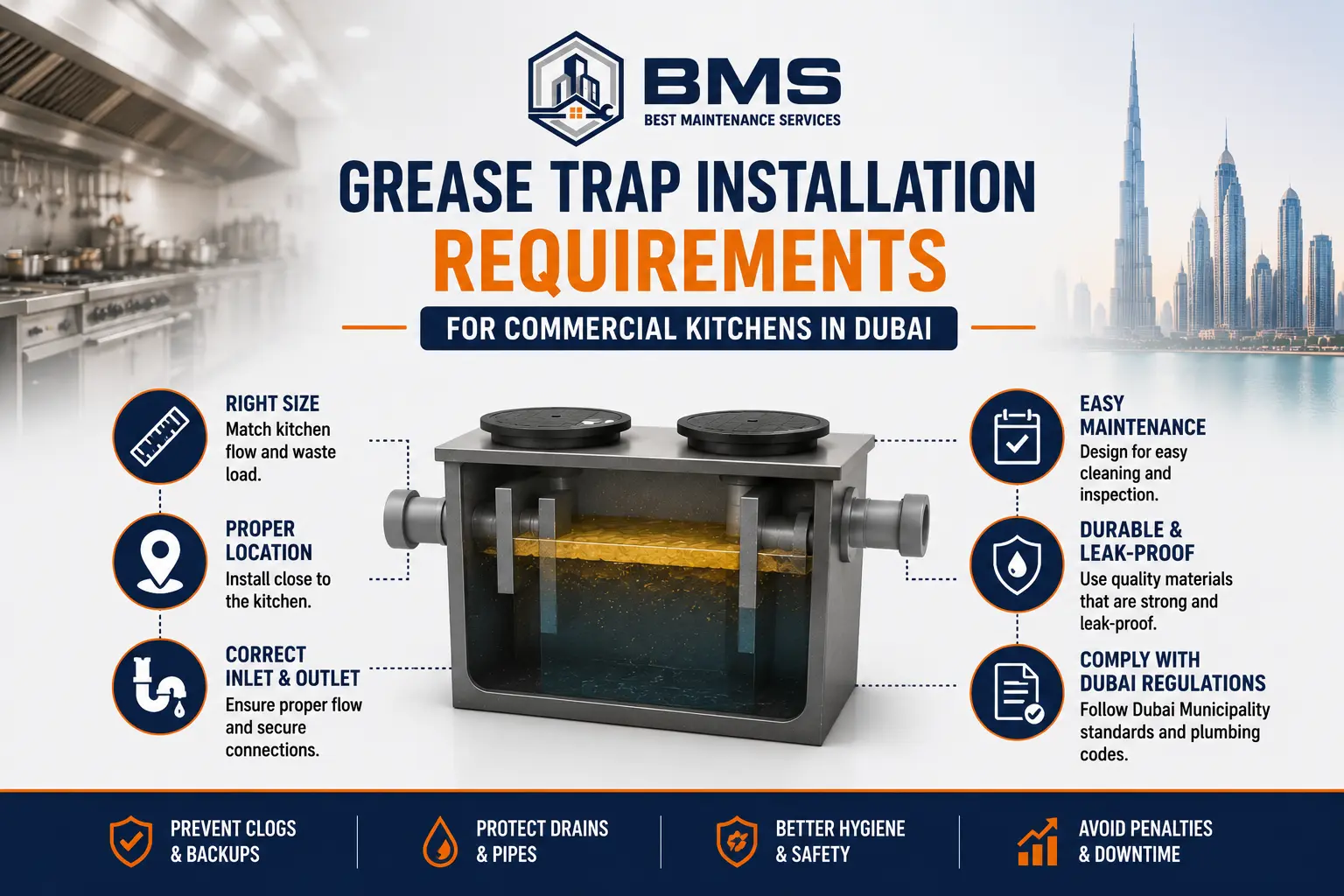
Running a commercial kitchen in Dubai comes with serious responsibilities and one of the most important is managing fats, oils, and grease (FOG) before they ever reach the drainage network. Whether you operate a restaurant in Business Bay, a cloud kitchen in Al Quoz, or a hotel kitchen in Jumeirah, installing the right grease trap system is not optional. It protects your drainage pipes, keeps your kitchen compliant, and saves you from expensive emergency repairs down the line.
Not every grease interceptor suits every kitchen. The right choice depends on your kitchen size, daily cooking volume, the type of food you prepare, and the layout of your drainage system. Getting the sizing, location, and connection wrong from day one creates blockages, overflows, and foul odors problems that disrupt service and damage your business reputation.
This guide walks you through everything you need to know about grease trap installation requirements for commercial kitchens in Dubai from choosing the right capacity and material, to understanding where to place the unit, how it connects to your drainage system, and what factors affect the installation cost. Whether you are planning a new kitchen fit-out or replacing an old unit, the information below will help you make the right decision.
To learn more about keeping your drainage system healthy, explore our guides on drain cleaning services Dubai and grease trap installation two services that work hand-in-hand with proper grease trap installation.
Why Commercial Kitchens Need a Proper Grease Trap System
How Fats, Oils and Grease Enter Kitchen Drainage
Every commercial kitchen produces FOG fats, oils, and grease during daily cooking. When dishwashing water, pan rinse water, and food-prep runoff flow into the sink, they carry dissolved grease into the kitchen drain. That warm grease stays liquid while it flows, but as it cools inside the drainage pipes it solidifies and sticks to pipe walls.
What Happens When Grease Reaches the Drainage Network
Grease accumulation inside drainage pipes causes slow drains, blockages, and eventually complete backups. In a high-volume commercial kitchen, this can happen within weeks of installation if no grease trap is in place. Beyond your own pipes, uncontrolled FOG discharge into the municipal sewer network is a violation of Dubai Municipality commercial kitchen hygiene requirements.
How a Properly Selected Trap Helps Protect Kitchen Drains
A correctly sized and installed grease interceptor separates FOG from kitchen wastewater before it enters the drainage system. The grease floats to the surface inside the trap chamber, while the cleaner water flows out through the outlet into the drain line. Regular servicing then removes the accumulated grease and sludge from the retention chamber, keeping the system working properly.
What Should Be Considered Before Installing a Grease Trap?
Kitchen Size and Daily Wastewater Volume
A larger kitchen with more cooking equipment generates significantly more grease-laden wastewater per day. The daily wastewater volume, measured by flow rate, directly determines the minimum capacity of the grease trap you need. Undersizing the unit is one of the most common and costly installation mistakes.
Number of Sinks and Drainage Fixtures
Every sink, floor drain, dishwasher outlet, and prep area drain that handles FOG-contaminated water should connect to the grease interception system. Count all fixtures before selecting a unit to ensure the trap can handle the combined flow rate.
Type of Food Preparation
A deep-fry-heavy restaurant kitchen produces far more grease than a café serving sandwiches and pastries. Heavy cooking operations grills, fryers, woks, rotisseries require a higher-capacity grease arrestor than light food-preparation kitchens.
Expected FOG Load
Not all FOG is the same. Animal fats, cooking oils, and butter produce different levels of grease waste. Kitchens that cook high volumes of meat, use large quantities of vegetable oil, or produce fried foods daily need a system that can retain more grease between service intervals.
Available Installation Space
The physical size of the unit must fit within the available kitchen area or external space. Under-sink models are compact but limited in capacity. Above-ground and external units offer larger capacity but require more space and planning.
Existing Drainage Layout
The existing drainage layout including pipe direction, floor levels, and connection points affects where the grease trap can be installed and how the inlet and outlet pipes connect. A proper site inspection before installation identifies any drainage modifications needed.
Access for Inspection and Maintenance
A grease trap that cannot be easily opened, inspected, and emptied will not be serviced regularly. Poor access is a design problem that creates long-term maintenance problems. The installation location must allow sufficient space around and above the unit for routine servicing.
Future Kitchen Expansion
If your kitchen operation is likely to grow, selecting a slightly larger unit now avoids the cost of replacement later. Consider your planned capacity, not just your current volume.
How to Choose the Right Grease Trap Size
Why Grease Trap Capacity Matters
Capacity is the single most important factor in grease trap selection. An undersized grease trap fills up too quickly, loses efficiency, and lets grease pass through to the drainage pipes. An oversized unit wastes space and budget. The right grease trap capacity matches your actual kitchen wastewater flow rate.
Flow Rate and Fixture Load
Grease trap sizing is calculated by measuring the combined flow rate of all connected kitchen fixtures sinks, dishwashers, floor drains, and prep areas. The higher the combined flow rate, the larger the grease interceptor needed.
General Grease Trap Sizing Reference
| Kitchen Type | Typical Capacity | Notes |
|---|---|---|
| Small café / coffee shop | Under-sink unit | Low FOG load, limited fixture count |
| Mid-size restaurant | Above-ground unit | Moderate-to-high FOG, multiple fixtures |
| Cloud kitchen / catering | High-capacity unit | High daily volume, large flow rate |
| Hotel / central kitchen | External / project-specific | Very high volume, multiple kitchen zones |
| Food court / high-volume kitchen | Project-specific system | Multiple food operators, peak-hour surges |
For detailed kitchen-by-kitchen sizing guidance, refer to our grease trap installation and supply Dubai service page, where our team can help you calculate the correct capacity for your operation.
Where Should a Grease Trap Be Installed?
Under-Sink Installation
Under-sink grease traps are compact units installed directly beneath a kitchen sink. They are suitable for small cafés, coffee shops, and light-use commercial kitchens with low FOG loads and limited drainage connections. They are easy to install but have limited capacity and require more frequent servicing.
Above-Ground Installation
Above-ground units are installed inside the kitchen on the floor, close to the drainage connection point. They offer higher capacity than under-sink models and are practical for mid-size restaurants with moderate to high cooking volumes.
External Installation
External grease interceptors are installed outside the kitchen building often in a designated drainage area or plant room. They are suitable for large commercial kitchens, hotel operations, catering facilities, and food courts where internal space is limited and high capacity is essential.
Choosing the Right Location for Access and Servicing
Regardless of the installation type, the unit must be placed where service technicians can open the access cover, inspect the chamber, and pump out the contents safely. Tight spaces, overhead obstructions, and sealed locations make maintenance difficult and reduce service frequency.
What to Consider When Space Is Limited
When kitchen floor space is limited, consider whether an external installation is feasible. Coordinate with your kitchen designer, MEP contractor, and fit-out team early in the planning process to ensure the grease trap location is integrated into the layout, not added as an afterthought.
Common Location Problems to Avoid
⚠ Placing the unit in a sealed or hard-to-reach area
⚠ Installing too far from the drainage fixtures (reduces flow efficiency)
⚠ Blocking access with equipment or storage after installation
⚠ Failing to account for service vehicle or technician access for external units
What Type of Grease Trap Is Suitable for a Commercial Kitchen?
Stainless Steel Grease Traps
Stainless steel grease interceptors are durable, hygienic, and resistant to corrosion in a commercial kitchen environment. They are ideal for high-volume restaurants, hotel kitchens, and catering facilities where the unit handles large quantities of hot, grease-laden wastewater every day. Stainless steel is easy to clean and maintains performance over a long service life.
PVC and uPVC Grease Traps
PVC and uPVC grease traps are a cost-effective option for lower-to-medium volume kitchens. They are lightweight, easy to install, and corrosion-resistant. They work well for cafés, small restaurants, and food-service businesses where the FOG load is moderate and the installation location is straightforward.
Under-Sink Models
Under-sink grease traps available in stainless steel or PVC are compact and designed for kitchens with space constraints. They intercept grease at the point of source before it enters the main drainage line.
Above-Ground Units
Above-ground grease interceptors offer more capacity than under-sink models while still fitting inside the kitchen. They connect to multiple drainage fixtures and handle a higher combined flow rate.
Project-Specific Grease Trap Systems
Large commercial projects hotel kitchen fit-outs, food court drainage systems, and central kitchen facilities often require custom or project-specific grease trap configurations. These are designed based on the actual flow rates, kitchen layout, and site conditions of the specific project.
How Material and Design Affect the Installation
The material of the grease trap affects its weight, installation requirements, and connection method. Stainless steel units are heavier and may require additional structural support. PVC units are lighter and faster to install. Your installer should select the right combination of material, capacity, and connection design for your specific kitchen drainage layout.
How a Grease Trap Connects to the Kitchen Drainage System
Kitchen Fixtures That Typically Connect to the System
All kitchen fixtures that handle FOG-contaminated water should feed into the grease trap. These typically include the main kitchen sinks, pot-washing sinks, dishwasher outlets, floor drains in the cooking area, and food-prep area drains.
Inlet and Outlet Connections
The grease trap connects to the kitchen drainage system through an inlet pipe that receives wastewater from the kitchen fixtures and an outlet pipe that discharges the treated water to the main drainage line. The internal baffle inside the trap separates the grease (which floats upward) from the cleaner water that exits through the outlet.
Kitchen Fixtures → Inlet Pipe → Grease Trap Chamber → Internal Baffle → Outlet Pipe → Drainage Line → Sewer Connection
Pipe Routing and Drainage Flow
Proper pipe routing ensures that wastewater flows into the trap at the correct rate and direction. Incorrect pipe angles, sharp bends, or excessive horizontal pipe runs before the trap can reduce flow efficiency and cause sedimentation inside the pipework.
Maintaining Proper Flow Through the Trap
The grease trap must receive wastewater at a flow rate within its design capacity. If the flow rate exceeds the trap capacity for example, when multiple fixtures discharge at the same time during peak kitchen hours grease can pass through the trap without being separated.
Why Poor Connections Can Cause Drainage Problems
Incorrect inlet or outlet connections, loose pipe fittings, or improper pipe sizing can cause leaks, drainage backups, and reduced trap efficiency. All connections should be inspected and tested after installation before the kitchen goes into operation.
Regular Drain cleaning Services can help remove grease buildup and keep commercial kitchen drainage lines flowing properly.
Grease Trap Installation Requirements for Different Commercial Kitchens
Restaurants
Restaurants in Dubai from casual dining outlets in Deira to fine-dining venues in DIFC typically require above-ground or external grease interceptors with enough capacity to handle peak-hour dishwashing, cooking, and food-prep volumes. A site inspection is essential to identify the right model and location.
Cafés and Coffee Shops
Cafés and coffee shops produce lower FOG loads than full-service restaurants, but they still require a properly sized grease trap for compliance with Dubai Municipality commercial kitchen hygiene requirements. Under-sink or compact above-ground units are often suitable.
Cloud Kitchens
Cloud kitchens operate at high cooking volumes with limited dining space. Many cloud kitchen facilities in Al Quoz and Dubai Silicon Oasis run multiple cuisine brands from a single kitchen. These operations often require higher-capacity grease interceptors to handle the combined wastewater from multiple cooking lines.
Hotel Kitchens
Hotel kitchens in Palm Jumeirah, Downtown Dubai, and Jumeirah serve large numbers of guests across multiple dining outlets and banquet functions. These operations produce very high daily volumes of grease-laden wastewater and typically require large external or project-specific grease trap systems designed for their specific drainage infrastructure.
Catering and Central Kitchens
Catering companies and central production kitchens produce large batches of food for distribution. Their continuous cooking operations generate high FOG loads that require robust, high-capacity grease interception systems with reliable maintenance schedules.
Food Courts and High-Volume Kitchens
Food courts in shopping malls from Al Barsha to Business Bay often include multiple food operators sharing a drainage infrastructure. In these settings, a shared large-capacity or project-specific grease trap system manages the combined FOG discharge from all operators.
Food Production and Commercial Food Facilities
Food manufacturing and production facilities that process meat, oils, and other FOG-generating ingredients require industrial-scale grease separation systems. The installation in these facilities must be coordinated with the overall wastewater management plan for the building.
What Access Does a Grease Trap Need After Installation?
Access for Inspection
The inspection cover of the grease trap must be accessible at all times. Your service technician needs to open the cover, visually check the grease and sludge levels, and assess whether the unit needs pumping. A unit that cannot be inspected quickly is a unit that will not be serviced properly.
Access for Servicing
Grease trap servicing involves removing the accumulated grease layer and sludge from the trap chamber. For above-ground and under-sink units, this is done manually or with portable equipment. For large external units, a service vehicle with a vacuum tanker may be needed. Ensure vehicle access is available if this applies to your installation.
Space Around the Unit
Minimum clear space around the grease trap allows the service technician to work safely and efficiently. Avoid installing equipment, shelving, or storage directly over or beside the unit after installation.
Cover and Connection Accessibility
The access cover must open fully without obstruction. Inlet and outlet connections should also be accessible for inspection and in the event that a pipe connection needs attention.
Why Inaccessible Installation Creates Problems
✗ Servicing is skipped or delayed because access is too difficult
✗ Grease and sludge accumulate beyond safe levels
✗ The trap overflows into the drainage pipes or kitchen floor
✗ Emergency drain cleaning is required at much higher cost
✗ Kitchen operation is disrupted during urgent maintenance
Common Grease Trap Installation Mistakes
Choosing the Wrong Capacity
An undersized grease interceptor fills up rapidly, loses its separation efficiency, and lets FOG pass through to the drainage network. An undersized trap causes more problems than no trap at all in high-volume kitchens. Always base the capacity selection on the actual combined flow rate of all connected fixtures.
Installing the Unit in an Inaccessible Location
A grease trap placed beneath a fixed worktop, inside a sealed cavity, or in a location blocked by equipment becomes impossible to service properly. The result is a trap that is never emptied and a drainage system that eventually fails.
Poor Pipe Connections
Incorrectly connected inlet or outlet pipes, loose fittings, or mismatched pipe diameters cause leaks and reduce trap efficiency. All pipe connections must be properly sealed and tested before the kitchen goes into operation.
Incorrect Drainage Routing
Excessive horizontal pipe runs, incorrect pipe gradients, or sharp bends between the kitchen fixtures and the grease trap reduce flow rates and create areas where grease can solidify in the pipework before reaching the trap.
Ignoring Kitchen Flow Requirements
Failing to account for peak-hour water usage when multiple sinks, dishwashers, and floor drains run simultaneously leads to overloading the trap during the busiest periods. The trap must be sized for peak flow, not average flow.
Using an Unsuitable Material or Model
Selecting a low-capacity PVC under-sink unit for a high-volume restaurant kitchen is a sizing and material mismatch. The wrong model fails prematurely and requires premature replacement.
Failing to Plan for Future Kitchen Demand
Kitchens grow. If you plan to add cooking equipment, extend your menu, or expand your seating capacity, install a grease trap that can accommodate increased FOG loads. Replacement costs are always higher than upgrading at the original installation.
Installing Without Considering Project Documentation
Commercial kitchen projects in Dubai may require specific product information, installation details, and supporting documentation as part of the fit-out or approval process. Confirm these requirements with your contractor, consultant, or the relevant authority before installation.
What Documentation or Approval Support May Be Needed?
Product and Model Information
Commercial kitchen projects often require documented product specifications for the grease trap including model details, material, capacity, and technical specifications. Confirm what documentation your contractor or consultant needs before ordering the unit.
Installation Details
Some projects require a record of the installation location, pipe connections, and unit specifications as part of the kitchen fit-out documentation package.
Documentation for Commercial Kitchen Projects
Dubai Municipality sets out commercial kitchen hygiene requirements that apply to food-service facilities. Specific documentation and inspection requirements vary by project type, building, and the scope of the kitchen fit-out. Requirements may also differ depending on whether the project involves a new fit-out, a renovation, or a change of use.
When to Confirm Requirements Before Installation
Always confirm any local authority, building, or project-specific requirements with your MEP contractor, consultant, or the relevant authority before the installation begins. Do not assume that requirements are uniform across all projects in Dubai.
Working With Your Contractor, Consultant or Fit-Out Team
A professional grease trap installer works alongside your MEP contractor, kitchen consultant, and fit-out team to ensure the installation aligns with the project plan, drainage layout, and any required documentation. Clear coordination avoids costly changes after installation.
How Professional Grease Trap Installation Works
1. Site and Kitchen Assessment
The installation team inspects the kitchen, identifies all drainage fixtures that produce FOG-laden wastewater, and records the available installation space and current drainage layout.
2. Understanding the Drainage Layout
The team reviews the existing plumbing and drainage connections to determine the best inlet and outlet routing for the grease trap.
3. Selecting the Appropriate Model
Based on the kitchen type, fixture count, flow rate, and available space, the installer recommends the correct grease trap model, material, and capacity.
4. Confirming Size and Connections
The team confirms the unit dimensions, connection sizes, and pipe specifications to ensure compatibility with the kitchen drainage system.
5. Preparing the Installation Location
The installation area is prepared including any drainage modifications, surface preparation, or structural support required for the unit.
6. Installing the Grease Trap
The unit is positioned and secured in the confirmed location, ready for pipe connections.
7. Connecting the Inlet and Outlet
Inlet and outlet pipes are connected using the correct fittings and sealed to prevent leaks. Pipe routing is checked for correct gradient and flow direction.
8. Checking Flow and Connections
Water flow is tested through all connected fixtures to confirm that the grease trap is receiving wastewater correctly and that all connections are secure.
9. Final Handover and Documentation
The team provides a handover, explains the recommended service interval, and supplies any documentation required for the project file.
For wider drainage, pipework, and water-system issues, our Plumbing Services in UAE can provide professional support for commercial properties.
How Much Does Grease Trap Installation Cost in Dubai?
What Determines the Installation Price?
Grease trap installation cost in Dubai varies based on several factors. There is no single fixed price because each kitchen project has different requirements different unit sizes, materials, drainage layouts, and installation complexity.
Key Cost Factors for Grease Trap Installation
| Cost Factor | How It Affects the Price |
|---|---|
| Grease trap size & capacity | Larger units cost more than compact under-sink models |
| Material (stainless steel vs. PVC) | Stainless steel units carry a higher purchase price |
| Installation complexity | Complex drainage modifications add labour cost |
| Pipework and connection requirements | New pipe runs or drainage alterations increase scope |
| Installation location (indoor vs. external) | External installations may require additional groundwork |
| Quantity (single unit vs. project supply) | Bulk or project orders may qualify for better pricing |
| Documentation support | Projects requiring certificates or registration support may incur additional fees |
Standard grease trap units start from AED 500–800 for basic under-sink models. Above-ground commercial units range from AED 1,200–3,500+ depending on capacity and material. Large external or project-specific systems are priced based on the specific scope of supply and installation. Contact Best Maintenance Services for a transparent, itemised quote.
Why You Should Compare the Complete Installation Scope
When comparing quotes, look beyond the unit price alone. A complete installation scope includes the grease trap unit, all pipework and fittings, connection labour, drainage testing, and any documentation support required. A lower unit price that excludes essential installation work may cost more overall.
When Should a Commercial Kitchen Replace Its Grease Trap?
The Existing Unit Is Too Small
If your kitchen has expanded, your menu has grown, or you have added cooking equipment since the original installation, the existing grease trap may no longer have the capacity to handle the increased FOG load.
The Trap Is Damaged or Corroded
Cracked, corroded, or structurally compromised grease traps cannot retain grease effectively. A damaged unit must be replaced rather than repaired.
Connections Are Failing
Leaking inlet or outlet connections, degraded pipe fittings, or loose seals indicate that the system is no longer functioning correctly. These problems often indicate that a replacement is more cost-effective than ongoing repairs.
The Kitchen Has Expanded
New kitchen equipment, additional sinks, or extended cooking areas increase the wastewater volume. If the current unit cannot handle the additional load, replacement or supplementary installation is needed.
The Existing Installation Is Difficult to Access
If the current grease trap was installed in an inaccessible location and servicing has been skipped as a result, replacement with a properly positioned unit resolves the long-term maintenance problem.
The Current System No Longer Matches the Kitchen Layout
Kitchen renovations, drainage modifications, or layout changes may leave the existing grease trap in the wrong position relative to the current drainage connections.
If your commercial kitchen or facility also needs property improvements, our Painting Services in Dubai can help maintain a clean and professional environment.
How to Choose a Grease Trap Supplier and Installer in Dubai
Check the Available Models
A reliable grease trap supplier in Dubai should offer a range of models including under-sink, above-ground, stainless steel, PVC/uPVC, and project-specific options so that your kitchen gets the right unit for its specific requirements.
Confirm Sizing Support
Your supplier and installer should be able to help you determine the correct grease trap size based on your kitchen's fixture count, flow rate, and daily cooking volume. A supplier who only sells units without providing sizing guidance is not giving you a complete service.
Ask About Installation Scope
Confirm that the installation service includes site inspection, pipe connections, drainage testing, and a completed handover. A professional installation is not just placing the unit on the floor.
Check Documentation Support
If your commercial kitchen project requires documentation, product certificates, or installation records, confirm that your supplier and installer can provide this support as part of the service.
Confirm Warranty Coverage
Ask about the product warranty for the grease trap unit and the workmanship warranty for the installation. A reliable company stands behind the quality of both the product and the installation work.
Request a Clear Installation Quote
Request a detailed, itemised quote in AED that covers the unit, pipework, fittings, labour, and any documentation support. Avoid suppliers who provide vague pricing without a clear scope of work.
Make Sure the Installer Understands Commercial Kitchens
Grease trap installation in a commercial kitchen is not the same as a residential plumbing job. Your installer should understand commercial kitchen drainage, wastewater flow rates, FOG management, and kitchen hygiene requirements not just basic plumbing.
- Best Maintenance Services has 5+ years of experience in commercial kitchen maintenance across Dubai and the UAE.
- 500+ satisfied customers residential, commercial, and industrial.
- 200+ completed villa and commercial maintenance projects in Dubai.
- Experienced, trained technicians with advanced equipment.
- Transparent, real pricing in AED with no hidden charges.
- Fast response across Dubai from Business Bay to Al Barsha, JLT to Palm Jumeirah.
- Listed on Fixpert Solutions UAE's trusted home-services marketplace.
Frequently Asked Questions About Grease Trap Installation
Does every commercial kitchen need a grease trap?
Yes. Any commercial kitchen that produces fats, oils, and grease during food preparation must install a grease trap or grease interceptor. This includes restaurants, cafés, cloud kitchens, hotel kitchens, catering operations, and food courts. Dubai Municipality commercial kitchen hygiene requirements apply to food-service facilities across the UAE.
What size grease trap does a restaurant need?
The size depends on the combined flow rate of all drainage fixtures in the kitchen sinks, dishwashers, floor drains, and prep area drains as well as the volume and type of food being cooked. A site assessment by an experienced installer is the most reliable way to confirm the correct capacity.
Where should a grease trap be installed?
As close as practical to the kitchen drainage fixtures, in a location that allows easy access for inspection and servicing. Common options include under the sink, above-ground inside the kitchen, or in an external drainage area outside the building.
Can a grease trap be installed under a sink?
Yes. Under-sink grease traps are suitable for small cafés, coffee shops, and low-to-medium FOG-load kitchens. They intercept grease at the point of source. However, they have limited capacity and require more frequent servicing than larger above-ground units.
What type of grease trap is best for a commercial kitchen?
Stainless steel units are the most durable and hygienic choice for high-volume commercial kitchens. PVC and uPVC units are suitable for lower-to-medium volume operations. The best type for your kitchen depends on your FOG load, available space, and budget.
How much does grease trap installation cost in Dubai?
Standard under-sink units start from AED 500–800. Above-ground commercial units range from AED 1,200–3,500+ depending on capacity and material. Large or project-specific systems are priced based on the full scope of supply and installation. Contact Best Maintenance Services for an itemised quote.
Can an existing grease trap be replaced?
Yes. If your current unit is undersized, damaged, inaccessible, or no longer matches your kitchen drainage layout, it can be removed and replaced with a suitable new unit. The new installation should be sized based on your current and anticipated future kitchen volume.
How long does grease trap installation take?
A standard above-ground or under-sink installation typically takes half a day to one full working day, depending on the drainage connection requirements. External installations or project-specific systems may require longer depending on the scope of work.
Can a grease trap be installed outside?
Yes. External installation is a practical option for large commercial kitchens, hotel operations, and food courts where internal space is limited. External units must be positioned to allow service vehicle access if vacuum tanker servicing is required.
Does grease trap installation require documentation?
This depends on the nature of the commercial kitchen project, the building, and the fit-out scope. Some projects require product specifications, installation records, or certificates as part of the approval or fit-out documentation process. Confirm requirements with your contractor, consultant, or the relevant authority before installation.
How do I know which grease trap is suitable for my kitchen?
The most reliable approach is to have an experienced installer conduct a site assessment of your kitchen. They will review the fixture count, drainage layout, available space, and FOG load to recommend the correct model, capacity, and installation location for your specific operation.
Final Checklist Before Installing a Grease Trap
• ☑ Count all drainage fixtures that will connect to the grease trap
• ☑ Calculate or confirm the combined flow rate with your installer
• ☑ Identify the available installation space indoor or external
• ☑ Confirm the unit capacity matches your peak-hour flow rate, not just average flow
• ☑ Select the appropriate material stainless steel or PVC/uPVC for your kitchen type
• ☑ Plan the inlet and outlet pipe routing before installation
• ☑ Ensure the chosen location allows easy access for inspection and servicing
• ☑ Check whether your project requires documentation or product certificates
• ☑ Coordinate with your contractor, MEP team, and fit-out consultant
• ☑ Request a detailed, itemised quote in AED before confirming the installation
• ☑ Confirm the service interval after installation with your maintenance provider
Get the Right Grease Trap for Your Kitchen
Protect your kitchen drainage with the right grease trap, professional installation, and reliable support. Contact Best Maintenance Services today for a clear quote and expert guidance across Dubai and the UAE.
.
Need a quote or technical guidance?
Share your emirate, property or business type, relevant photos, site access details and preferred timing. BMS will confirm the appropriate next step.