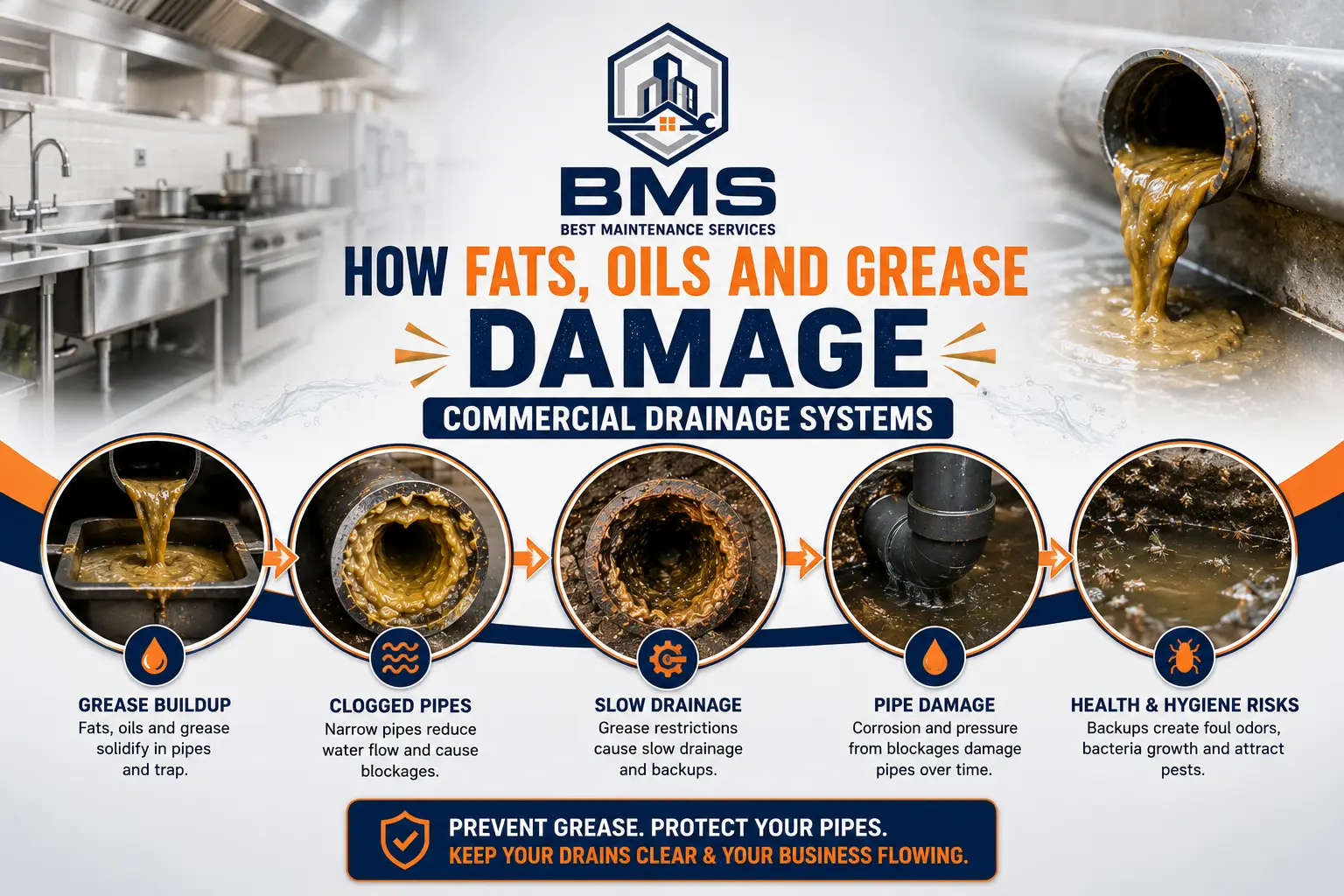
Fats, oils and grease (FOG) can quietly build up inside commercial drainage pipes, causing slow drains, odors, blockages and costly backups. Learn how FOG damages commercial kitchen…
A commercial kitchen can look clean while its drainage system is slowly becoming restricted.
Where does the grease go after washing a greasy pan or plate? Some of it can enter the drainage system, where fats, oils and grease (FOG) may stick to cooler pipe surfaces. Over time, this buildup can narrow the flow path, trap food particles, slow drainage, and contribute to odors or backups.
This is why commercial drainage cleaning is more than clearing a blocked drain. Restaurants, hotels, cloud kitchens, and catering facilities in Dubai need to manage grease buildup to maintain reliable wastewater flow and reduce recurring drainage problems.
If your kitchen already has slow drains, bad odors, gurgling, or recurring backups, the problem may be deeper inside the drainage line. Professional drain cleaning services in Dubai can help identify and remove suitable blockages before they cause greater disruption.
What Are Fats, Oils and Grease (FOG)?
Fats, oils and grease (FOG) are common wastewater contaminants produced during food preparation and kitchen cleaning. They include cooking oils, animal fats, butter, dairy residue, oily sauces, and grease washed from cookware and equipment.
What Produces FOG in a Commercial Kitchen?
FOG can enter commercial drainage systems through everyday kitchen activities:
- Deep fryers and frying areas — cooking oil and food grease
- Grills and ovens — animal fats and cooking residue
- Dishwashing areas — grease left on plates, pans, and utensils
- Preparation sinks — fats from meat, fish, dairy, and sauces
- Floor drains — grease and food residue from kitchen cleaning
For kitchens dealing with regular grease discharge, proper grease trap maintenance is also an important part of drainage management.
Why Does FOG Cause Drainage Problems?
Hot grease may flow easily at first. As it cools inside drainage pipes, it can become thicker and adhere to pipe surfaces. Additional grease and food particles can then collect on the buildup.
The result? The usable space inside the pipe gradually becomes smaller, restricting wastewater flow and increasing the risk of a commercial drain blockage.
That is where commercial drainage cleaning becomes important—particularly when grease-related drainage problems keep returning.
How FOG Builds Up Inside Commercial Drainage Pipes
FOG builds up when fats, oils and grease cool inside drainage pipes and adhere to the pipe walls. New grease can then collect on the existing layer, while food particles and other debris become trapped in the buildup. Over time, the passage for wastewater becomes narrower and drainage can slow.
For commercial kitchens, this is a gradual process. The first signs may be easy to miss, but recurring buildup can eventually contribute to blocked commercial drains, bad odors, slow wastewater flow, and backups.
What Happens When Hot Grease Enters a Drain?
Hot cooking oil and fatty residue can flow easily when they leave a fryer, sink, or kitchen equipment. The problem begins as the wastewater moves into cooler sections of the commercial drainage pipe.
As the temperature falls, some grease can become thicker and adhere to the inside of the pipe.
How Does Grease Stick to Pipe Walls?
Cooling grease can form deposits on the inner surface of a drainage pipe. Each new discharge may add to existing residue, particularly where grease repeatedly enters the same drainage line.
Over time, this can create a thicker grease buildup inside the pipe, reducing the space available for wastewater to flow.
How Do Food Particles Get Trapped?
Grease buildup can create a sticky surface that catches food particles, organic waste, and other debris moving through the drainage system.
This mixture can become denser and harder to remove as deposits accumulate. In busy commercial kitchens, repeated exposure to grease and food waste can make drainage maintenance increasingly important.
How Does FOG Restrict Wastewater Flow?
As grease accumulation increases, the open area inside the pipe becomes smaller. Wastewater then has less space to move through the line.
The first warning signs may include:
- Slow kitchen sinks
- Water draining slowly from floor drains
- Gurgling sounds
- Recurring unpleasant odors
- Water pooling around drainage points
- Repeated commercial drain blockages
At this stage, the problem may still be manageable with appropriate commercial drainage cleaning before a more serious backup occurs.
Can Grease Buildup Cause a Complete Drain Blockage?
Yes, heavy FOG buildup can contribute to a severe or complete blockage, particularly when grease combines with food debris and other material.
However, not every partial blockage will become complete. The outcome depends on factors such as grease volume, pipe size, drainage design, wastewater flow, existing deposits, and maintenance practices.
This is why recurring grease buildup should be addressed rather than repeatedly treating only the visible symptoms. Professional commercial drain cleaning can help identify the extent of buildup and determine whether cleaning, inspection, or ongoing maintenance is appropriate.
7 Ways FOG Can Damage a Commercial Drainage System
Fats, oils and grease (FOG) can affect a commercial drainage system gradually. As grease deposits accumulate, they can restrict wastewater flow, trap food debris, create odors, and increase the risk of blockages and backups.
Here are seven common ways FOG can affect commercial drainage systems.
1. It Reduces the Available Space Inside Drain Pipes
As grease deposits build up on pipe walls, the open space available for wastewater becomes smaller. This restricts flow and can make the drainage system less efficient.
The effect is gradual, which means a kitchen may continue operating normally while buildup is developing inside the pipes.
2. It Causes Slow Drains and Recurring Blockages
Slow drainage is often an early warning sign of buildup. Kitchen sinks may take longer to empty, while floor drains may hold water after washing or cleaning.
If the same drain repeatedly becomes slow or blocked, the problem may be more than a temporary obstruction. Recurring grease buildup can continue restricting the line unless the underlying cause is addressed.
3. It Traps Food Waste and Other Debris
Grease can create a sticky surface that catches food particles, organic matter, and other debris moving through the drainage system.
As these materials combine with existing grease deposits, the buildup can become thicker and more difficult to remove. This can turn a relatively small restriction into a more serious commercial drainage problem.
4. It Can Cause Persistent Drain Odors
Grease buildup can trap organic waste inside drainage pipes. As this material remains in the system, it can contribute to unpleasant or persistent drain odors.
If a commercial kitchen continues to smell despite normal surface cleaning, the source may be deeper inside the drainage system and may require inspection and cleaning.
5. It Can Contribute to Drain and Sewer Backups
When grease and debris significantly restrict a drainage line, wastewater may no longer flow normally.
This can result in water backing up through sinks, floor drains, or other drainage points. In a commercial kitchen, even a localized backup can create hygiene concerns and disrupt normal operations.
6. It Can Affect Downstream Drainage Lines
FOG does not always remain near the point where it enters the system. If grease passes beyond a grease trap or grease interceptor, it can continue into downstream drainage pipes.
This means a blockage may sometimes occur farther along the system rather than directly beneath the kitchen sink or floor drain. When the location is unclear, commercial drain cleaning or CCTV inspection can help determine where the restriction is located.
7. It Can Disrupt Normal Kitchen Operations
A serious drainage blockage can quickly become an operational problem.
Sinks may become unusable, dishwashing can be interrupted, cleaning activities may slow down, and staff may need to work around affected areas. For restaurants, hotels, and other food-service businesses, unexpected kitchen drainage problems can therefore create significant disruption during busy periods.
Regular inspection, appropriate grease management, and timely commercial drainage cleaning can help identify buildup before it develops into a more disruptive blockage.
How Grease Moves From the Kitchen Into the Drainage System
FOG enters a commercial drainage system during normal kitchen activities, but the amount that reaches downstream pipes depends on how well the kitchen’s grease-control system is designed and maintained. Understanding this journey makes it easier to see why grease problems can begin long before a drain actually blocks.
It Starts With Everyday Kitchen Activity
Grease can enter wastewater when staff rinse greasy cookware, plates, utensils, preparation areas, and kitchen equipment. Floor washing can also carry food residue and grease toward floor drains.
Not all of this material should reach the wider drainage network. A properly designed kitchen drainage system uses appropriate controls to reduce the amount of FOG that travels downstream.
FOG Then Travels Through the Drainage Line
Once grease enters the wastewater, it moves through branch drainage pipes with the water.
As the wastewater cools, some fats and grease can become less fluid and adhere to the internal surfaces of the pipe. Deposits may be more noticeable around pipe bends, junctions, connections, and areas where flow is slower.
Over time, repeated deposits can combine with food particles and other debris, creating a restriction inside the drainage line.
Where Does the Grease Trap Fit In?
A grease trap or grease interceptor is designed to separate fats, oils and grease from wastewater before they travel farther into the drainage system.
The basic principle is simple: the device slows wastewater sufficiently for grease and other floatable material to separate from the water. The retained grease then needs to be removed through appropriate grease trap maintenance and cleaning.
A grease trap is therefore not a substitute for good kitchen practices or drain maintenance. It is one part of the overall wastewater management system.
What Happens When the Grease Trap Is Overloaded?
A grease trap has a limited capacity. As grease and solids accumulate, its ability to separate incoming material can be reduced.
If maintenance is delayed or the system is not correctly sized for the kitchen's wastewater load, more FOG may pass beyond the trap and enter downstream drainage pipes.
That is when a problem that began in the kitchen can gradually become a commercial drainage problem farther along the system.
Why Downstream Grease Buildup Is Harder to Deal With
Once FOG moves beyond the kitchen area, the affected pipe may be less accessible and more difficult to inspect.
A restriction farther down the line can also produce symptoms that seem unrelated to the original source, such as slow drainage, recurring blockages, unpleasant odors, or wastewater backups.
When the location or cause is unclear, commercial drainage cleaning and, where appropriate, CCTV drain inspection can help determine what is happening inside the pipe before deciding on the next cleaning or maintenance step.
For a broader look at drainage cleaning options, see our Drain Line Services in Dubai guide.
Warning Signs of FOG-Related Drainage Problems
Most commercial kitchen drainage problems give you early warning signals before they become emergencies. Knowing what to look for and acting quickly can save your business significant time and money.
| â Warning Sign | What It Usually Means |
| Slow kitchen sink or floor drain | Grease buildup restricting water flow |
| Persistent bad smell from drains | Decomposing FOG inside pipes |
| Gurgling or bubbling sounds | Restricted airflow due to blockage |
| Water backing up from floor drains | Partial or full blockage downstream |
| Grease visible around drain openings | FOG overflow from trap or pipes |
| Grease trap filling unusually fast | High FOG load or undersized trap |
| Drain problems returning soon after cleaning | Underlying buildup not fully resolved |
Any one of these signs is worth investigating. Multiple signs appearing together especially in a restaurant in JLT, a hotel kitchen in Palm Jumeirah, or a catering facility in Al Quoz often indicate a grease-related drain blockage that needs professional attention.
Why Commercial Kitchens Are Especially Vulnerable to FOG Problems
Commercial kitchens produce far more fats, oils and grease (FOG) than typical residential kitchens. Frequent cooking, food preparation, dishwashing, and floor cleaning can introduce grease and food residue into the drainage system throughout the working day.
The risk is higher when grease enters the drains repeatedly and the drainage system or grease-control equipment is not properly maintained.
Which Businesses Are Most Exposed?
FOG-related drainage problems can affect many food-service operations, including:
- Restaurants and cafés regular frying, grilling, and dishwashing
- Hotels multiple kitchens and high-volume food preparation
- Cloud kitchens intensive cooking within compact facilities
- Catering businesses large-scale food preparation
- Food courts and cafeterias multiple kitchens using shared drainage infrastructure
- Bakeries and food-production facilities frequent use of oils, fats, butter, and dairy products
The higher the grease load and wastewater volume, the more important proper grease management, drainage maintenance, and timely cleaning become.
FOG Problems in Different Parts of a Commercial Kitchen
Grease-related drain problems are not limited to one part of the kitchen. They can affect every section of the drainage system from the individual sink to the external sewer connection.
Kitchen Sinks and Wash Areas
Sinks and wash areas see the highest volume of cooking oil buildup and food residue. This is where grease accumulation in drains typically begins.
Floor Drains
Floor drains collect grease splatter, food waste, and wash-down water from the entire kitchen floor. Without regular cleaning, floor drain backup is a common outcome in high-volume kitchens.
Grease Traps and Interceptors
The grease trap is the first line of defence but only when it is properly sized, installed, and maintained. A full grease trap is a grease trap that has stopped doing its job.
Branch Drainage Lines
These are the pipes connecting individual sinks and floor drains to the main drain line. Grease deposits in branch lines are common and are often the cause of recurring blockages in specific kitchen areas.
Main Wastewater Lines and External Sewer Connections
When FOG in sewer lines reaches the main drainage, the problem is much harder to clear without professional equipment. CCTV pipe inspection is often the most reliable way to identify blockages this far downstream.
Grease Trap vs Drainage Pipe: Why Both Need Attention
What the Grease Trap Is Designed to Do
A commercial grease trap captures FOG before it enters the wider drainage network. It works by slowing down wastewater and allowing grease to separate and float to the surface inside a sealed chamber.
What Happens When the Trap Becomes Overloaded
A full grease trap cannot separate FOG effectively. The grease simply passes through directly into the downstream drain pipes where it begins to coat the pipe walls and cause grease drain blockage further down the system.
Why Cleaning the Trap Alone May Not Solve a Downstream Blockage
This is a point that surprises many business owners. If your grease trap has been overloaded or neglected for some time, the drainage pipes downstream may already contain significant grease buildup in pipes. Cleaning the trap removes the source but the existing buildup inside the pipes remains until addressed separately.
When the Drainage Pipe Itself Needs Cleaning
If slow drainage or recurring backups continue after a grease trap cleaning, the pipes themselves likely need attention. Commercial drain cleaning either by mechanical means or hydro jetting is the appropriate next step. Our sewer line cleaning services are designed for exactly this situation.
When Recurring Blockages May Require CCTV Inspection
If the same drain keeps blocking even after cleaning especially in a kitchen that has already addressed its grease trap maintenance a CCTV drain inspection can reveal whether there is a structural issue, a hidden buildup point, or a problem further down the wastewater drainage system that needs to be addressed.
What Happens If a Commercial Kitchen Ignores FOG Buildup?
â Cost of Neglect What Ignoring FOG Really Means
Small restrictions become severe blockages. Odors grow harder to control. Drain backups disrupt service. Emergency maintenance becomes necessary. Repeated cleaning becomes more expensive. Underlying drainage problems go undetected until they become major repairs.
The cost of a scheduled grease trap cleaning in Dubai typically ranges from AED 300 to AED 900. The cost of an emergency drainage call-out with possible kitchen downtime, food waste, and health inspection risk can be many times higher. Ignoring FOG buildup is a false economy.
UAE food safety regulations require commercial kitchens to maintain sanitary conditions at all times. Persistent kitchen drain odors, wastewater backups, and grease-clogged drains can attract pest activity and create conditions that put your food safety compliance at risk. Dubai Municipality inspections do consider drainage and hygiene infrastructure as part of commercial kitchen assessments.
How Commercial Kitchens Can Prevent FOG-Related Drain Problems
The most effective grease management strategies are simple, practical, and consistent. They require staff awareness and straightforward procedures not expensive equipment.
Never Pour Cooking Oil Directly Into Drains
Used cooking oil should be collected in sealed containers and disposed of correctly. Pouring cooking oil buildup directly into a sink is one of the fastest ways to accelerate FOG accumulation in pipes. Many Dubai facilities contract licensed used cooking oil disposal services to manage this waste stream responsibly.
Scrape Food Solids Before Washing
Food waste removal before dishwashing significantly reduces the FOG load entering drains. Train all kitchen staff to scrape plates, pans, and trays into bins before washing including greasy sauces, fats, and oily food residue.
Keep Grease Traps Correctly Maintained
A well-maintained grease trap is the single most effective barrier between your kitchen and a commercial drain blockage. Schedule grease trap cleaning based on your kitchen's actual FOG output not a generic calendar.
Use Drain Screens and Floor Drain Maintenance
Fit drain screens and strainers at every sink and floor drain to catch food solids before they enter the drainage system. Clean kitchen floor drains regularly to prevent buildup at the entry point.
Monitor and Respond to Early Warning Signs
A slow drain or a persistent kitchen drain odor is a signal not something to ignore until it becomes an emergency. Responding early is always cheaper than responding to a full drain backup.
How Often Should Commercial Kitchens Check for FOG Buildup?
There is no single correct answer and anyone who gives you a universal schedule without knowing your kitchen should be viewed with some scepticism. FOG accumulation depends on a range of variables specific to each operation.
Key factors that affect FOG accumulation rate:
- Volume of cooking oil and animal fat used per service
- Number of covers or meals prepared per day
- Grease trap capacity and design relative to kitchen output
- Type of food being prepared (deep-fried vs. salad-based menus)
- Previous blockage history and last cleaning date
- Kitchen operating hours extended shifts mean more FOG output
A small café in Dubai Silicon Oasis may need grease trap maintenance every two to three months. A high-volume hotel kitchen in Downtown Dubai may need it monthly or more frequently. The best approach is to monitor your system and build a schedule around actual conditions not assumptions.
When Does a Commercial Kitchen Need Professional Drain Cleaning?
Some situations call for professional attention immediately. Do not wait for a complete blockage if you notice any of the following:
- The same drain keeps blocking even after basic cleaning
- Water backs up from floor drains during normal operations
- Multiple fixtures sinks, dishwashers, floor drains are all draining slowly
- Grease buildup is visible or suspected inside the drainage line
- Drain odors continue after basic cleaning and grease trap emptying
- A blockage returns shortly after the previous cleaning
- You suspect a main drainage or sewer-line problem based on multiple affected areas
In these situations, professional commercial drain cleaning including hydro jetting for heavy grease removal and CCTV drain inspection for accurate diagnosis is the appropriate response. DIY solutions will not resolve a stubborn grease blockage this deep inside the system. Explore our emergency plumbing cleaning services for urgent situations across Dubai.
How Professionals Remove FOG From Commercial Drainage Systems
A professional commercial drain cleaning visit is not simply sending a wire down the pipe. A good technician follows a structured process to identify the problem, select the right solution, and help prevent recurrence.
| Method | Best For | Typical Cost (AED) |
| Mechanical Drain Snaking | Soft blockages, partial clogs | 200 – 500 |
| Hydro Jetting | Heavy grease buildup, recurring blockages | 500 – 1,500 |
| CCTV Drain Inspection | Hidden blockages, repeat problems | 600 – 1,200 |
| Grease Trap Cleaning | FOG removal, trap maintenance | 300 – 900 |
Initial Assessment
The technician first identifies which drainage lines are affected and assesses the severity of the blockage whether it is a partial restriction, a complete grease blockage, or a structural problem.
Mechanical Drain Cleaning for Suitable Blockages
For lighter or more accessible blockages, a mechanical drain snake or drain auger can break up and remove the obstruction. This method works well for partial grease clogs in accessible sections of the drainage line.
Hydro Jetting for Heavy Grease Buildup
For heavy grease buildup or recurring blockages, hydro jetting is the most effective solution. High-pressure water is directed through the pipe to break up and flush out compacted FOG deposits, food waste, and other debris. This method cleans the full pipe interior not just the blockage point giving you a more complete result. Hydro jetting is most appropriate when the pipe condition has been assessed and confirmed suitable.
CCTV Inspection When the Cause Is Unclear
When a blockage keeps returning, or when the affected area is difficult to access, a CCTV drain inspection provides a live view of the pipe interior. This allows our team to identify exactly where the grease accumulation is located, whether there is structural damage, and what cleaning method is most appropriate.
Post-Cleaning Flow Check and Recurrence Prevention
After cleaning, the technician checks that wastewater flow has been fully restored. They also recommend practical steps to prevent recurrence including grease trap maintenance schedules, staff procedures, and preventive maintenance intervals tailored to your kitchen's actual FOG output.
FOG Prevention Checklist for Commercial Kitchens
Use this checklist to assess your kitchen's current FOG management practices. The more boxes you can tick confidently, the lower your risk of a grease drain blockage.
| â | Keep cooking oil out of drains collect used oil in sealed containers |
| â | Scrape food solids into bins before washing pots, pans, and utensils |
| â | Use drain screens and strainers at every sink and floor drain |
| â | Keep grease traps correctly maintained on a regular schedule |
| â | Clean kitchen floor drains weekly or as needed |
| â | Monitor slow drainage act before a partial blockage becomes complete |
| â | Investigate persistent kitchen drain odors immediately |
| â | Respond quickly to any drain backup do not delay |
| â | Keep maintenance records for inspections and cleanings |
| â | Schedule professional drainage inspection when problems keep returning |
If you cannot tick most of these boxes, your commercial drainage system is at elevated risk. Contact Best Maintenance Services to discuss a preventive maintenance plan designed around your kitchen's actual needs.
How to Choose a Commercial Drainage Maintenance Company in Dubai
Not every maintenance company that offers drain cleaning services Dubai has genuine experience with commercial kitchen drainage systems. Choosing the right partner makes a real difference to the quality and durability of the result.
- Look for commercial kitchen experience. Ask specifically about restaurant and food business projects not just residential drain cleaning.
- Ask how FOG buildup will be assessed. A professional team should inspect the system before deciding on a cleaning method.
- Check what cleaning method will be used. Hydro jetting and CCTV inspection should be available, not just basic drain snaking.
- Ask about preventive maintenance options. Recurring blockages are best addressed with a scheduled maintenance plan not repeated emergency call-outs.
- Check reviews and completed commercial projects. Real experience with Dubai businesses is a meaningful trust signal.
- Request transparent AED pricing. You should know the cost before work begins no hidden charges.
Best Maintenance Services is also listed on Fixpert Solutions, a trusted UAE home services marketplace, as a verified commercial maintenance provider giving you additional confidence in the quality and reliability of our team.
Why Dubai Businesses Trust Best Maintenance Services for FOG and Drainage
We have worked with restaurants, hotels, cloud kitchens, and commercial facilities across Dubai from Bur Dubai and Deira to Dubai Hills Estate and Mirdif for over five years. Our team understands the real-world challenges of commercial kitchen drainage in Dubai's climate and operating environment.
| â Trust Signal | What It Means for You |
| 5+ Years of Industry Experience | Proven expertise with Dubai's commercial drainage systems |
| 500+ Satisfied Customers | Trusted by restaurants, hotels, and facility managers across the UAE |
| 200+ Completed Villa & Commercial Projects | Hands-on experience with complex drainage situations |
| Advanced Hydro Jetting & CCTV Equipment | Deep grease removal and accurate blockage diagnosis |
| Transparent AED Pricing No Hidden Charges | You know the cost before work begins |
| Fast Response Across Dubai | From Business Bay to JLT, Al Barsha to Palm Jumeirah |
| Safe Waste Handling & Disposal | Compliant with Dubai Municipality regulations |
| Preventive Maintenance Plans Available | Stop recurring blockages before they cost more |
Best Maintenance Services is verified on Fixpert Solutions, a trusted UAE home services marketplace. This gives our clients additional confidence that they are working with a legitimate, reviewed, and professionally operated company.
Frequently Asked Questions About FOG and Commercial Drainage
What are fats, oils and grease in commercial wastewater?
FOG refers to fats, oils and grease produced in commercial kitchens during cooking and food preparation. These include cooking oils, animal fats, dairy residue, and oily food byproducts. They are the leading cause of commercial drain blockages in Dubai and across the UAE.
Why is FOG bad for commercial drains?
Unlike ordinary wastewater, grease does not mix with water. It solidifies on pipe walls, accumulates over time, and progressively restricts wastewater flow eventually causing blocked commercial drains, odors, and sewage backups.
How does grease cause drain blockages?
Hot grease enters the drain as a liquid, cools inside the pipe, and hardens onto the pipe walls. Food particles become trapped in the sticky layer. The grease buildup in drains grows thicker with each cooking session until water can no longer pass through freely.
Can grease damage drainage pipes?
Yes. Sustained FOG accumulation can cause pipe restriction, increase wastewater pressure, and in older or weakened pipes contribute to structural stress. The more immediate risk is operational: a blocked or restricted drainage pipe disrupts kitchen operations and creates hygiene risks.
Why does my commercial kitchen drain smell?
A bad smell from drain in a commercial kitchen is almost always caused by decomposing organic matter trapped in grease deposits inside the pipes. A rancid grease smell or sewer odor from the kitchen means the drainage system needs cleaning.
Can a grease trap prevent all drain blockages?
A correctly sized and regularly maintained grease trap significantly reduces the volume of FOG reaching downstream drainage pipes. But it is not a complete solution on its own. If the trap is overloaded, undersized, or overdue for grease trap cleaning, FOG will bypass it and enter the drainage system regardless.
What happens when a grease trap is full?
A full grease trap loses its separation ability. FOG flows directly into the downstream drainage and begins coating the pipe walls. The result is grease buildup in pipes beyond the trap a problem that requires professional commercial drain cleaning to resolve, not just a grease trap pump-out.
Is hydro jetting effective for grease buildup?
Hydro jetting is one of the most effective methods for removing heavy grease buildup from commercial drainage pipes. High-pressure water breaks up and flushes out compacted FOG deposits along the full length of the pipe not just at the blockage point. It should be carried out by trained technicians who have assessed the pipe condition beforehand.
When is CCTV drain inspection necessary?
A CCTV pipe inspection is recommended when the same drain keeps blocking after cleaning, when multiple fixtures are affected simultaneously, when the blockage location is unclear, or when you need to assess the condition of drainage pipes before or after a major cleaning. It removes the guesswork from commercial drain diagnosis.
How can businesses reduce recurring grease-related blockages?
The most effective combination is: scheduled grease trap maintenance, staff training on proper grease disposal, drain screens at every entry point, and periodic professional drain cleaning matched to your kitchen's actual FOG output. Reactive maintenance is always more expensive than planned maintenance.
Protect Your Commercial Drainage System From FOG
If a drain keeps blocking after cleaning, the blockage is often a symptom of an underlying problem not a problem that simply needs to be cleared again. That underlying problem is almost always FOG buildup that has accumulated over time and has not been fully addressed.
The good news is that FOG-related drain problems are among the most preventable commercial kitchen challenges. With the right grease management practices, regular grease trap maintenance, and periodic professional drainage cleaning, most businesses can avoid costly emergency situations entirely.
Ready to Protect Your Kitchen's Drainage? Contact Best Maintenance Services
Best Maintenance Services works with restaurants, hotels, cloud kitchens, and commercial facilities across Dubai to keep commercial drainage systems running efficiently. Whether you need a grease trap installation, a full commercial drain cleaning service, or a scheduled preventive maintenance plan, our team is ready to help.
Need a quote or technical guidance?
Share your emirate, property or business type, relevant photos, site access details and preferred timing. BMS will confirm the appropriate next step.