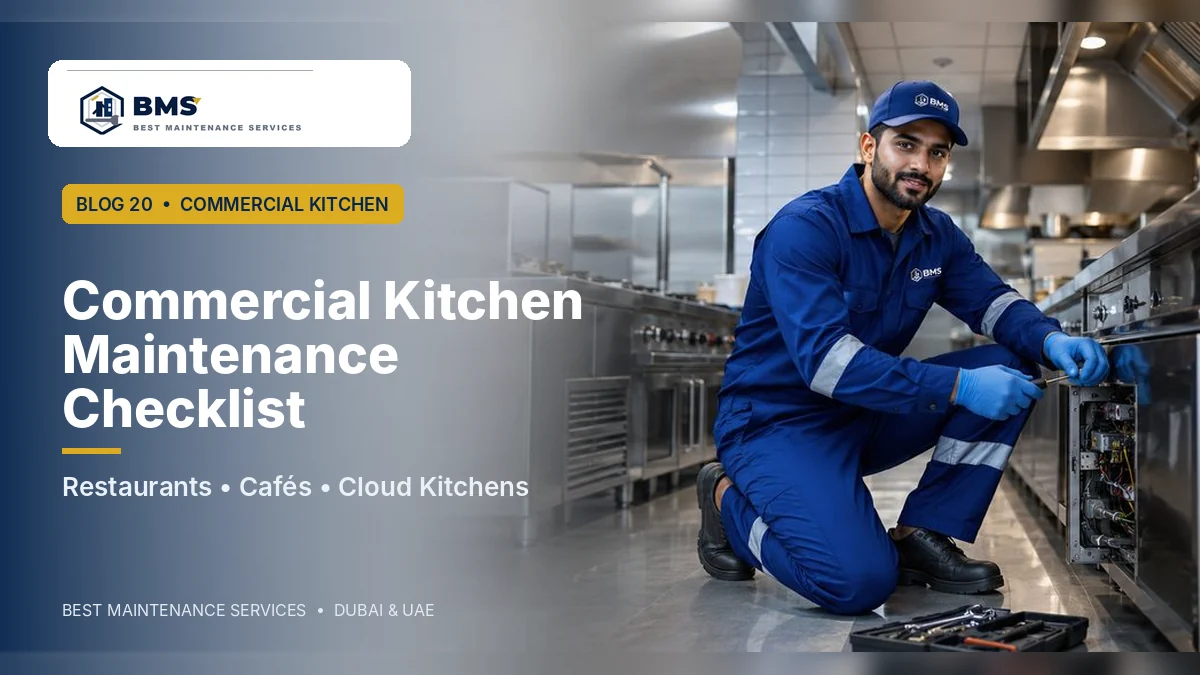
A Dubai commercial kitchen depends on drainage, grease control, extraction, electrical systems and cleaning working together. Use this maintenance checklist to organize daily, weekly…
A commercial kitchen is a group of connected systems. Sinks and drains carry wastewater, the grease trap controls fats and oils, the hood and exhaust system manages cooking emissions, electrical systems power equipment, cleaning protects working surfaces, and refrigeration or other kitchen equipment has its own service needs. If one part is ignored, the failure can affect the rest of the operation.
For restaurants, cafés, hotels, bakeries and cloud kitchens, a useful commercial kitchen maintenance checklist in Dubai separates daily operational tasks from specialist technical maintenance. Staff should know what they can inspect and clean, what requires a trained contractor, what needs a shutdown window and what must be documented for follow-up. The aim is planned maintenance with clear ownership—not a long checklist nobody uses.
1. Daily Opening and Closing Checks
- Confirm sinks, floor drains and wash areas are draining normally.
- Check for unusual odors, gurgling or standing water.
- Look for visible leaks around taps, flexible connections and equipment.
- Check that grease filters are seated correctly and not obviously overloaded.
- Keep grease trap and service access zones clear.
- Record equipment alarms, breaker trips or abnormal noises rather than repeatedly resetting them.
- Clean food-contact and surrounding surfaces according to the kitchen hygiene programme.
2. Drainage and Floor Drain Maintenance
Slow drainage is an early warning. Kitchen staff should prevent food solids, packaging and excessive FOG from entering drains and report repeated slow flow. Floor drains should remain accessible and should not be used as disposal points for grease or food waste.
When blockages recur, move from surface cleaning to professional drain cleaning or inspection. The BMS commercial drainage maintenance guide explains how preventive cleaning can be planned for busy sites.
3. Grease Trap / Grease Interceptor
Maintain a written service interval based on actual accumulation. Check for odor, high internal level, overflow, damaged covers, access problems and repeated downstream blockages. Do not wait for the trap to overflow before booking service.
Keep a maintenance log containing service date, condition, work completed, defects and next due date. If kitchen production changes, review both cleaning frequency and capacity. BMS provides grease-trap supply, sizing, installation and replacement as a dedicated scope. Routine trap pumping, emptying and cleaning must be arranged separately.
4. Hood, Filters, Duct and Exhaust Fan
Separate routine filter/visible-surface cleaning from specialist internal extraction maintenance. Filters may need frequent attention, while duct and fan frequency should reflect grease loading, inspection results and relevant site requirements.
Record which parts were actually cleaned. The related BMS hood/exhaust guides explain why a shiny canopy does not necessarily mean the duct and fan are clean. Use Kitchen Hood, Duct & Exhaust Services when specialist access is needed.
5. Plumbing Fixtures and Water Supply
- Check taps/mixers for leakage and secure operation.
- Inspect visible flexible hoses and isolation valves for deterioration.
- Watch for low or changing water pressure.
- Check under sinks for moisture or cabinet damage.
- Report toilets or staff washroom fixtures that run continuously or block repeatedly.
- Know the relevant isolation points before an emergency.
6. Electrical Safety and Distribution
Kitchen equipment creates significant electrical demand. Staff should report repeated breaker trips, hot plugs, damaged sockets, loose accessories, burning smells, water near electrical equipment or equipment that shocks users. Protective devices should never be bypassed to keep a kitchen operating.
Planned electrical inspections and corrective work belong under a qualified Electrical Services scope. Coordinate shutdowns so high-impact equipment can be tested without disrupting peak service.
7. Refrigeration, Cooling and Equipment
Follow manufacturer and specialist requirements for refrigerators, freezers, chillers, cooking equipment and other appliances. Record temperature or alarm concerns through the kitchen’s food-safety procedures and arrange technical work before repeated faults become breakdowns.
Keep ventilation openings, coils or service clearances accessible where the equipment design requires them. Do not allow storage to block maintenance access.
8. Cleaning & Hygiene Beyond Daily Wiping
Daily staff cleaning does not always reach behind equipment, high-level surfaces, heavy grease deposits or specialist systems. Schedule deeper cleaning based on kitchen load and condition. The BMS Kitchen Deep Cleaning Dubai guide distinguishes general kitchen cleaning from grease-trap equipment requirements, drain cleaning and internal exhaust maintenance.
Avoid unsupported health claims in service documentation. Record the physical cleaning scope and areas completed.
9. Building Fabric and Access
- Repair failed sealant around wet areas.
- Investigate ceiling/wall staining before finishes are repainted.
- Keep service hatches accessible.
- Check floor damage that traps water or grease.
- Maintain safe anti-slip conditions in wet/service areas.
- Protect pipe, duct and electrical access during fit-out changes.
10. Maintenance Records and Defect Register
A checklist should create actions. Use an asset or defect register with date, system, finding, priority, contractor, work completed and next action. Attach photographs for recurring or hidden issues. This prevents the same problem from being rediscovered by each new shift or contractor.
| System | Useful record |
|---|---|
| Drainage | Blockage location, method used, recurring pattern. |
| Grease trap | Condition, cleaning date, defects, next service. |
| Hood/exhaust | Components inspected/cleaned, access issues, next due date. |
| Electrical | Circuit/equipment involved, diagnosis, corrective work. |
| Equipment | Asset ID, fault, parts/work, follow-up. |
| Cleaning | Areas completed, exclusions, next planned deep clean. |
11. Weekly and Monthly Management Review
Once a week, review unresolved defects, recurring drain complaints, grease-trap status, hood/filter issues and equipment alarms. Monthly, look for patterns: repeated call-outs to the same drain, more frequent grease loading, recurring breaker trips, leakage or ventilation complaints.
Recurring faults deserve root-cause work rather than another identical reactive visit. The maintenance manager should decide whether a specialist inspection, replacement or system modification is needed.
12. Plan Shutdown Work Before It Becomes an Emergency
Some work is much easier when the kitchen is not producing food: drain jetting, grease trap replacement, duct access, electrical isolation or equipment replacement. Use quieter periods to complete preventive work with protection and testing rather than waiting for an emergency during peak service.
For multi-trade work, coordinate one documented shutdown plan but keep each contractor’s technical scope clear.
A Simple Maintenance Frequency Matrix
| Frequency | Examples |
|---|---|
| Daily / shift | Visible leaks, drainage flow, filters/hood condition, equipment alarms, cleaning. |
| Weekly | Review defects, inspect access zones, verify unresolved issues. |
| Monthly / periodic | Plumbing condition, deeper cleaning, service records, selected technical inspections. |
| Condition-led specialist | Drain cleaning, grease trap service, duct/fan cleaning, electrical testing, equipment repair. |
| Annual / planned review | Full maintenance strategy, recurring-fault analysis, asset condition and budget planning. |
What to Send When Requesting BMS Commercial Kitchen Maintenance
- Exact property and kitchen location.
- Business/kitchen type and operating hours.
- List of systems or faults requiring attention.
- Photos/videos of visible problems where safe.
- Access and shutdown restrictions.
- Previous service history for recurring issues.
- Any landlord/site permit or coordination requirements.
Build a Maintenance System, Not a Collection of Emergency Call-Outs
The most valuable commercial kitchen checklist is the one that helps the manager act before service is interrupted. Keep it short enough for daily use, detailed enough for monthly review, and connected to specialist records. If an issue repeats, escalate it from routine task to diagnosis.
BMS provides commercial kitchen maintenance services in Dubai together with specialist drain cleaning, hood/exhaust, electrical and cleaning services, plus grease-trap sizing, supply, installation and replacement. A structured request lets the team route each task correctly while coordinating access and timing for the kitchen as a whole.
Site Information That Improves the Assessment
For commercial kitchen maintenance Dubai, a useful enquiry includes the exact kitchen location, business type, operating hours, photographs of the trap and connected sink area, the last known service date, and a short description of any overflow, odor or downstream blockage. If drawings, model information or previous service records exist, include them. These details help separate a capacity, installation, maintenance and drainage problem before unnecessary work is proposed.
For an operating kitchen, also explain when the problem is worst: during opening preparation, peak lunch or dinner service, pot washing, or after a particular sink is used. Timing can reveal whether the system is being overwhelmed by peak flow, whether one connection is creating the issue, or whether a downstream restriction is affecting several fixtures.
Commercial Kitchen Decision and Handover Standard
A professional result should be understandable after the technician leaves. The handover should identify what was inspected, what condition was found, what work was completed, any limits on the inspection, defects that remain, and the next recommended action. Where a new unit or modification is proposed, the customer should be able to see how the recommendation relates to current kitchen demand, available space and future maintenance access.
This record is especially important for landlords, facility managers and multi-site restaurant operators. It reduces repeated diagnosis, gives the next contractor useful history and helps management see whether the same failure is returning despite routine servicing.
Avoid Solving the Wrong Problem
Grease-trap faults and commercial drain faults often appear together. An interceptor can be maintained correctly while the outlet pipe remains grease-lined, or a drain can be cleaned while an undersized or damaged trap continues to overload it. The most cost-effective approach is to identify which part of the system is responsible before repeating the same service.
BMS keeps grease-trap sizing, supply, installation and replacement separate from drain cleaning and wider commercial-kitchen maintenance. That structure makes quotations clearer and gives customers a direct route to the service that actually owns the problem.
Questions to Confirm Before Approving the Work
Before approving work related to commercial kitchen maintenance Dubai, confirm the symptom or operational objective, what has already been tried, the exact scope included, any exclusions, the access or shutdown required, and how completion will be verified. This avoids a common maintenance problem where the customer and contractor use the same service name but expect different work.
For corrective work, ask what evidence supports the recommended action and what would change the recommendation. For planned maintenance, ask what condition will be checked at the next visit and how the interval should be adjusted if the system is loading faster or slower than expected. These questions turn the service from a one-off transaction into a controlled maintenance decision.
Property and Operations Context Matters
The same issue described in Commercial Kitchen Maintenance Checklist for Restaurants, Cafés & Cloud Kitchens in Dubai can have different consequences in a villa, apartment tower, restaurant, hotel or managed commercial site. Access permissions, occupied areas, service hours, equipment shutdown, noise, protection of finishes and coordination with building management can all affect the practical method even when the technical fault is similar.
Tell BMS about those constraints before attendance. A technically correct repair or cleaning method still needs to fit the property safely and with the least reasonable disruption. Where several trades are involved, each technical scope should remain separately documented even if the visit is coordinated.
Use the Result to Prevent Recurrence
After the immediate work is complete, record the root cause where it is known, the condition found, parts or areas serviced, and any prevention advice that is specific to the property. If the same symptom returns, compare it with the previous record instead of starting from assumptions.
Recurring maintenance records are valuable because they reflect real questions customers ask and help future service decisions. BMS can use anonymized recurring problem patterns, genuine project photographs and verified service experience to improve future guidance without inventing claims or copying generic advice.
Final approval should record the diagnosed condition, completed scope, verification result, responsible follow-up action and next review date so the maintenance history remains useful.
Where a fault has operational consequences, the customer should also record access limitations, shutdown time, photographs and any recommendation that was deferred. This helps the next visit begin with evidence instead of repeating the same checks.
For managed properties, assign the follow-up to a named person and confirm whether the issue is closed, being monitored or requires a separate quotation. Clear status prevents technical recommendations from being lost after the immediate symptom disappears.
The final service record should confirm the condition found, the scope completed, the test or observation used to verify the result, and any follow-up that remains the customer's responsibility.
Need a quote or technical guidance?
Share your emirate, property or business type, relevant photos, site access details and preferred timing. BMS will confirm the appropriate next step.
Frequently Asked Questions
What should a commercial kitchen maintenance plan cover?
It should cover routine cleaning and inspection plus specialist drainage, grease trap, hood/exhaust, electrical, equipment and facility tasks relevant to the site.
How often should restaurant maintenance be scheduled?
Different tasks need different frequencies. Use manufacturer guidance, operating load, inspection findings, service history and applicable property or authority requirements to set intervals.
Why keep maintenance records for each kitchen system?
Records show what was serviced, defects found, recurring failures and upcoming tasks, helping managers plan work before breakdowns disrupt operations.