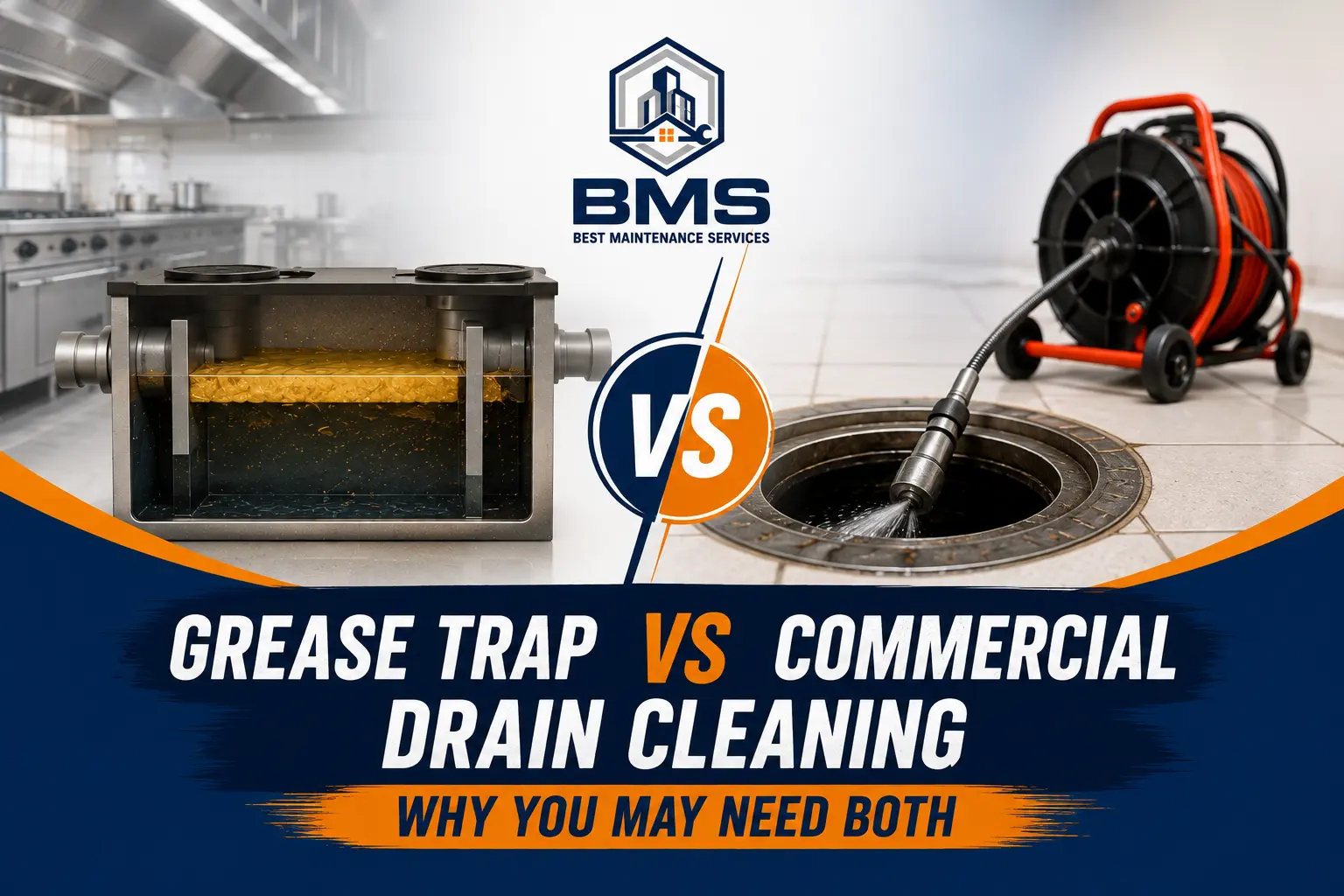
Grease trap cleaning and commercial drain cleaning solve different problems. Learn how each service works, when your kitchen needs one or both, and how regular maintenance helps prevent…
Most restaurant owners and facility managers in Dubai notice a slow kitchen drain and assume the grease trap is the problem. They call for a grease trap cleaning, the team does a great job, and within a few weeks the drain is slow again. Sound familiar? The truth is, your grease trap and your commercial drainage pipes are two separate systems. Each one collects different types of waste, works in a different part of your kitchen's wastewater path, and needs its own maintenance. Cleaning one does not automatically clean the other.
This confusion costs commercial kitchens time and money every year. When a restaurant grease trap is cleaned but the drain lines are still carrying years of accumulated FOG (fats, oils, and grease), food particles, and sediment, blockages will keep coming back. Understanding the difference between grease trap cleaning and commercial drain cleaning is the first step to protecting your kitchen's drainage system properly.
This guide explains exactly what each service does, when you need one or the other and when your kitchen actually needs both. Whether you manage a high-volume restaurant in Business Bay, a cloud kitchen in Al Quoz, or a hotel kitchen in Palm Jumeirah, this practical guide will help you make smarter maintenance decisions. For more on related services, you can also read about our drain cleaning services Dubai and grease trap installation service that support commercial kitchens across the UAE.
What Is the Difference Between a Grease Trap and a Commercial Drain?
What a Grease Trap Is Designed to Do
A grease trap also called a grease interceptor is a specially designed chamber that sits between your kitchen fixtures and the main sewer connection. Its only job is to intercept fats, oils, and grease before they enter the drainage system. When warm, greasy wastewater flows into the trap, it slows down. Grease floats to the top, solids settle to the bottom, and relatively cleaner water flows out.
Over time, the accumulated grease sludge and solids fill up the chamber. When that happens, the trap stops working properly and FOG begins to escape into your drainage pipes which is exactly the problem grease traps are designed to prevent. Dubai Municipality requires commercial kitchens to install and maintain grease traps as part of the UAE food safety and wastewater management standards.
What Commercial Drainage Pipes Are Designed to Do
Your kitchen's commercial drainage system is a network of pipes, branch lines, floor drains, and a main drain that carry all wastewater away from your kitchen and into the sewer connection. These pipes handle everything water from sinks, dishwashers, floor cleaning, and any waste that passes through or bypasses the grease trap.
Drainage pipes are designed to move water, not to filter it. When grease, food waste, soap scum, scale, and debris accumulate inside these pipes, the flow becomes restricted. Over time, even small deposits build up into serious pipe blockages that cause slow drains, backups, and overflows.
Where Each System Sits in the Wastewater Pathway
Here's the simple flow: Kitchen fixtures (sinks, floor drains, dishwashers) → Grease Trap → Branch Drainage Lines → Main Drain Line → Sewer Connection. The grease trap catches FOG before it reaches the pipes. But if the trap is full, poorly sized, or bypassed, grease escapes into the drain lines where it solidifies and causes blockages further downstream.
Why Both Systems Matter in a Busy Commercial Kitchen
In high-volume commercial kitchens such as those in hotels, food courts, and large restaurants huge quantities of FOG enter the wastewater system every single day. A properly maintained grease trap reduces what reaches the drain lines. But it can't stop everything. Commercial drain cleaning addresses the buildup that still accumulates inside the pipes over time, keeping the entire drainage network flowing smoothly.
How Grease Moves Through a Commercial Kitchen Drainage System
Where Fats, Oils and Grease Come From
In any food service kitchen, FOG comes from cooking oils, meat fats, butter, dairy products, sauces, and food residue washed off plates and pots. Every rinse, every dishwasher cycle, every floor cleaning sends some level of grease into the wastewater flow. In busy kitchens like those serving hotels or catering companies in Dubai, this happens hundreds of times per day.
What Happens When Wastewater Leaves the Kitchen
Warm wastewater carries grease in a liquid form through your drain fixtures. Once it hits cooler pipe surfaces, grease begins to cool and solidify. Over time, layer after layer of solidified grease builds up on the inner walls of drainage pipes, slowly narrowing the available space for water to flow through. This is how a fully functional drainage system becomes a recurring problem.
How a Grease Trap Captures FOG
A correctly installed and sized grease interceptor slows the wastewater flow enough for separation to happen. Lighter grease floats to the surface. Heavier solids sink to the bottom. The water layer in the middle flows out toward the drainage pipes. This is why regular grease trap servicing is so important when the trap is too full to work properly, none of this separation happens.
What Happens to Grease That Reaches the Drain Line
Any grease that escapes the trap or enters the drainage system from floor drains that bypass the trap travels into your branch and main drain lines. Combined with food particles, scale, and soap residue, this creates dense deposits inside the pipes. Hydro jetting and mechanical cleaning methods are specifically designed to remove this type of build-up from commercial drainage pipes.
How Buildup Can Eventually Restrict Wastewater Flow
Partial blockages start as slow drains. Without intervention, they progress into complete stoppages, wastewater backups, and drainage overflows. For a restaurant operating under Dubai Municipality hygiene inspections, a drainage overflow is not just a maintenance problem it is a compliance issue that can result in fines or temporary closure.
What Does Grease Trap Cleaning Actually Remove?
Accumulated Fats, Oils and Grease
Grease trap pumping removes the thick, solidified FOG layer that has accumulated at the surface of the trap. In high-volume kitchens, this can amount to a significant quantity of waste that needs to be transported and disposed of in compliance with UAE environmental regulations.
Floating Grease and Settled Solids
A complete grease trap service also removes the sludge layer at the bottom of the trap food solids, organic matter, and settled debris that decomposes over time and generates the strong, unpleasant grease trap odors that kitchen staff often report. This two-layer removal is essential for restoring the trap to its full working capacity.
Food Residue and Trapped Waste
Grease traps also accumulate food debris that escapes dishwashers and sinks. This organic material accelerates grease buildup and generates grease trap blockages that prevent clean separation. Regular cleaning removes this layer before it creates a more serious problem.
Why an Overloaded Trap Can Affect Downstream Drainage
Here is the key point many kitchen managers miss: a full grease trap does not just stop working it actively pushes accumulated FOG downstream into your drain lines. This is how a grease trap overflow problem quickly becomes a commercial drain blockage problem as well. Maintaining the trap protects the pipes.
What Does Commercial Drain Cleaning Actually Remove?
Grease Buildup Inside Drainage Pipes
Commercial drain cleaning targets the grease and FOG deposits that have already entered your drainage pipes. Even in kitchens with well-maintained grease traps, some grease inevitably reaches the pipes. Professional drain cleaning particularly hydro jetting uses high-pressure water to break down and flush out solidified grease from the inner pipe walls.
Food Particles and Organic Debris
Food waste, coffee grounds, soap scum, and organic residue combine with grease inside drainage pipes to create dense, sticky deposits. Standard drain cleaning methods including mechanical rodding and high-pressure water jetting are designed to dislodge and clear this type of blockage.
Sediment and Other Deposits
In older commercial properties and those served by Dubai's harder water, mineral scale and sediment accumulate inside drain lines over time. This reduces pipe diameter and creates turbulence that traps further debris. Professional drain cleaning removes scale and sediment to restore full pipe capacity.
Partial and Severe Blockages
Both partial blockages (which cause slow drainage) and severe blockages (which cause complete stoppages) can be addressed through commercial drainage cleaning methods. The right approach whether mechanical rodding, hydro jetting, or a combination depends on the severity and location of the blockage.
Buildup in Branch and Main Drainage Lines
Commercial drain maintenance covers the entire drainage network from individual fixture drain lines to branch pipes and the main drain. This whole-system approach is what prevents recurring blockages that keep affecting the same fixtures.
Grease Trap Cleaning vs Commercial Drain Cleaning
Understanding the difference between these two services clearly is the foundation of a good commercial kitchen maintenance strategy. Here is a direct side-by-side comparison:
| Factor | Grease Trap Cleaning | Commercial Drain Cleaning |
|---|---|---|
| Focus | Grease trap unit only | Drainage pipes and lines |
| What It Removes | Accumulated FOG, floating grease, solids | Pipe buildup, blockages, debris, scale |
| Primary Goal | Manage grease at the source | Restore and maintain wastewater flow |
| Scope | Trap-level maintenance | Drain-line and branch pipe maintenance |
| Protects | Downstream drainage from FOG | Full drainage network from blockages |
| Frequency | Based on kitchen volume and FOG output | Based on drainage load and pipe condition |
| Methods Used | Manual pumping, vacuum tanker, sludge removal | Hydro jetting, rodding, CCTV inspection |
Why One Service Cannot Always Replace the Other
Grease trap cleaning is a targeted, trap-level service. It restores the trap's ability to intercept FOG but it does not clean the pipes downstream. Commercial drain cleaning treats the pipes but cannot fix an overloaded grease trap that is pushing FOG into those same pipes. Both systems work together. Neglecting one affects the other.
When Grease Trap Maintenance May Be Enough
If your drain lines are flowing well and the only problem is a full or odorous grease trap, then a routine grease-trap cleaning on its own may be all that is needed. This is more common in newer installations where the drainage system is in good condition and regular maintenance has been consistent.
When the Drainage Line Needs Separate Cleaning
If drains are slow, recurring blockages keep appearing after trap cleaning, or multiple fixtures are affected, the drain lines need professional attention regardless of the trap's condition. Emergency drain cleaning is sometimes required when a blockage has caused wastewater backup in a live kitchen environment.
Why a Clean Grease Trap Does Not Guarantee Clean Drains
This is one of the most important things to understand about commercial kitchen drainage maintenance. Many restaurant managers believe that a freshly cleaned grease trap means the entire drainage system is fine. That is not always the case.
Grease Can Accumulate Before or After the Trap
Grease doesn't only accumulate inside the trap. The short pipe sections between kitchen fixtures and the trap can accumulate grease deposits just as easily. And any FOG buildup that escapes the trap particularly from a previously overloaded trap remains inside the downstream drain lines even after the trap has been cleaned.
Older Buildup May Remain Inside the Drainage Line
If your kitchen has been operating for several years without scheduled commercial drain cleaning, years of solidified grease, scale, and food waste may be lining your pipes. Cleaning the grease trap removes new FOG at the source but it cannot clear the layers of buildup already inside the drainage network.
Food Waste Can Combine With Grease
Food particles that pass through floor drains and sinks mix with grease inside the pipes, creating dense pipe blockages that are far harder to remove than grease alone. This is why restaurants with high food waste volumes bakeries, catering facilities, hotel restaurants need regular drain maintenance in addition to grease trap servicing.
Pipe Scale and Sediment Can Create Additional Restrictions
Mineral deposits and pipe scale can accumulate independently of FOG especially in older properties. These deposits create additional restrictions in the drainage line that grease trap cleaning has no ability to address. Only direct professional drain cleaning can resolve this type of buildup.
Structural Pipe Problems Cannot Be Solved by Trap Cleaning
Cracked pipes, collapsed sections, root intrusion, or severely corroded pipe walls are structural problems that no amount of grease trap maintenance will fix. When blockages persist despite proper trap cleaning and drain maintenance, a CCTV drain inspection is needed to identify whether a structural defect is contributing to the problem. You can explore our CCTV drain inspection Dubai service for exactly this type of assessment.
7 Signs Your Commercial Kitchen May Need Drain Cleaning
Your drainage system will usually give you warning signs before a blockage becomes a crisis. Here are seven signals that your commercial drain lines need professional attention.
1. Kitchen Sinks Are Draining Slowly Water taking longer than usual to drain from sinks is one of the earliest signs of grease buildup inside the drain lines. Don't ignore it.
2. Floor Drains Are Backing Up Water pooling around floor drains during kitchen operations points to a restriction in the drain line serving those fixtures.
3. The Same Drain Keeps Blocking Recurring blockages in the same location suggest a buildup or structural issue that goes beyond a simple one-time cleanout.
4. Multiple Fixtures Become Slow When several sinks and floor drains are all draining slowly at once, the problem is likely in a shared branch line or the main drain rather than a single fixture.
5. Persistent Drain Odors Ongoing bad smells from floor drains and sinks even after cleaning indicate decomposing organic matter and grease buildup inside the pipes.
6. Gurgling or Bubbling Sounds These sounds occur when air is being pushed back through the drainage system by a partial blockage downstream. It is an early warning sign worth investigating.
7. Blockages Return Shortly After Cleaning If a blockage clears quickly but returns within days or weeks, partial residual buildup is almost certainly still lining the drain pipe walls.
| â Quick Tip: Don't Wait for a Full BlockageSlow drains are your drainage system's way of asking for help. The earlier you address them, the lower your maintenance cost and the less likely you are to face an emergency drain cleaning situation during a busy service period. |
Signs the Grease Trap May Be the Problem
Not every drainage problem originates in the drain lines. Sometimes, the grease trap is the root cause. Here is how to tell:
â Trap is Visibly Full When the grease and solids layers take up more than 25% of the trap's depth, it needs cleaning. A visual check is the simplest way to assess this.
â Strong Odors from the Trap Area Decomposing grease and food solids generate sulfurous, unpleasant smells. If the odor is concentrated around the trap access point, the trap needs servicing.
â Grease Accumulating Unusually Quickly If you find the trap filling up faster than usual, your kitchen's FOG output may have increased perhaps due to a change in menu or higher customer volume.
â Wastewater Flow Is Becoming Slower An overfull trap restricts the outlet flow, causing slow drainage across kitchen fixtures even when the drain pipes themselves are clear.
â Trap Is Overflowing or Backing Up Visible overflow from the trap access cover or wastewater backup near the trap is a serious sign requiring immediate grease trap service.
â Frequent Grease-Related Drainage Issues If your kitchen has a history of grease blockages despite trap cleaning, the trap may be undersized for your current operational volume.
When Should You Clean the Grease Trap and Drain Lines Together?
There are situations where cleaning the grease trap alone or the drain lines alone is not enough. These are the scenarios where scheduling both services at the same time is the most practical and cost-effective decision.
â Your kitchen handles large volumes of cooking oil daily
â Blockages keep returning after individual service calls
â The drainage system has a documented history of grease buildup
â The grease trap has not been maintained on a regular schedule
â Multiple drains and fixtures are draining slowly at the same time
â The kitchen is experiencing backups or drainage overflow
â You are preparing for a Dubai Municipality hygiene inspection
â A new commercial kitchen is being set up or taken over
For high-volume commercial operations hotels, food courts in malls, large restaurant groups in Downtown Dubai or Dubai Marina combining both services as part of a scheduled preventive maintenance plan is strongly recommended. It reduces emergency call-outs and keeps your kitchen compliant year-round.
What Causes Commercial Kitchen Drains to Block Even With a Grease Trap?
If you have a grease trap installed and still experience blocked commercial kitchen drains, you are not alone. This is a very common frustration and the causes are usually straightforward.
â Excessive FOG Entering the System A kitchen producing more FOG than its grease trap is designed to handle will consistently push grease downstream into the drain lines.
â Food Particles and Solids Solid food waste that bypasses strainers and enters the drainage system combines with grease to create dense, stubborn blockages.
â Grease Buildup in Downstream Pipes Years of partial FOG escape create layer after layer of solidified grease inside drain pipes, narrowing the available flow path.
â Mineral Scale and Sediment Hard water scale and sand or grit from cleaning activities build up inside pipes independently of grease, creating additional restrictions.
â Poor Drainage Design or Pipe Condition Incorrectly sloped pipes, shared drain lines with insufficient capacity, or aging pipes in poor condition will cause recurring problems regardless of maintenance frequency.
â An Overloaded or Unsuitable Grease Trap A grease trap that is too small for the kitchen's current output will consistently fail to intercept enough FOG, sending grease directly into the pipes.
â Lack of Preventive Drain Maintenance Without scheduled professional cleaning of the drain lines, gradual buildup progresses unchecked until a blockage occurs.
Which Commercial Drain Cleaning Method Is Right for Grease Buildup?
Choosing the right drain cleaning method depends on the type and severity of the blockage, the pipe material, and the age of the drainage system. Here is how professionals assess this.
Mechanical Drain Cleaning for Localized Blockages
Drain rodding using a drain auger is effective for soft, localized blockages that are accessible and within a reasonable distance of the access point. It is a lower-pressure method suitable for minor to moderate blockages in smaller-diameter pipes.
Hydro Jetting for Heavy Grease Deposits
Hydro jetting high-pressure water jetting is the most effective method for clearing heavy grease deposits, FOG buildup and compacted debris from commercial drain lines. Water pressures of up to 4,000 PSI can cut through solidified grease and flush the pipe walls clean. This is the preferred method for commercial kitchens dealing with recurring grease-related blockages. You can read more about our dedicated hydro jetting services for Dubai commercial properties.
CCTV Inspection When the Cause Is Unclear
When blockages recur without a clear cause, CCTV drain inspection sends a live camera through the pipe to identify exactly where buildup is concentrated, where a structural defect exists, or whether damage is contributing to the problem. This prevents guesswork and ensures that the right cleaning or repair method is applied to the right location.
Why Pipe Condition Should Be Considered Before High-Pressure Cleaning
Before applying high-pressure jetting to older pipes, a professional assessment of the pipe's structural condition is important. Severely corroded or cracked pipes can be damaged by aggressive jetting. Experienced drainage professionals assess pipe condition before selecting the cleaning method which is why working with a qualified commercial plumbing maintenance provider matters.
How CCTV Inspection Helps Find Recurring Drain Problems
If your commercial kitchen has experienced repeat drain blockages despite regular maintenance, CCTV drain inspection is the most reliable diagnostic tool available. Here is what it reveals:
â Live footage of buildup deposits inside the pipe walls
â Exact location of the blockage within the drainage network
â Evidence of cracked, collapsed, or root-damaged pipe sections
â Areas of persistent restriction that keep re-blocking after cleaning
â Whether cleaning, lining, or pipe repair is the appropriate next step
For commercial kitchens in Deira, Bur Dubai, and other areas with older infrastructure, CCTV inspection is particularly valuable. Older drainage systems can have subtle structural defects that no amount of cleaning will permanently resolve only repair or pipe rehabilitation addresses them properly. Our sewer line cleaning services team uses CCTV inspection to diagnose problems before any work begins.
How to Prevent Grease-Related Commercial Drain Problems
Prevention is always less expensive than emergency repair. These practical daily and operational steps reduce the rate of grease accumulation in both your grease trap and your drain lines.
â Keep cooking oil out of sinks Train kitchen staff to never pour used cooking oil down the sink. Collect it in sealed containers for proper disposal.
â Collect used oil correctly A used cooking oil collection program significantly reduces the FOG load entering your grease trap and drainage system.
â Remove food solids before washing Scraping plates and pots before washing dramatically reduces the volume of food debris entering the drainage system.
â Use appropriate drain strainers Install and maintain strainers on all kitchen sink and floor drain outlets to prevent solid debris from entering the drain lines.
â Maintain the grease trap Schedule regular grease trap cleaning based on your kitchen's FOG output not just when the trap is visibly full.
â Monitor kitchen floor drains Floor drains in commercial kitchens often bypass the grease trap and connect directly to the drainage system. These need regular attention.
â Address slow drainage early A slow drain is a warning sign, not a minor inconvenience. Early intervention is always cheaper than emergency drain unblocking.
â Schedule professional drainage maintenance Regular
A Simple Maintenance Plan for Commercial Kitchens
A well-structured kitchen drainage maintenance schedule protects your business from costly emergency call-outs and keeps you compliant with Dubai Municipality hygiene standards. Here is a practical framework to follow:
| Frequency | Who Does It | What to Do |
|---|---|---|
| Daily | Kitchen staff | Collect used oil, scrape plates before washing, check floor drains |
| Weekly | Staff / Supervisor | Inspect grease trap level, monitor slow drains, clean strainers |
| Monthly | Professional service | Grease trap cleaning (adjust by volume), drain maintenance check |
| Quarterly | Professional service | Scheduled commercial drain cleaning, inspect branch lines |
| Annual | Professional service | CCTV drain inspection, full drainage system review |
Adjust the frequency of grease trap cleaning based on your actual kitchen volume and the results of routine inspections. A hotel restaurant in Downtown Dubai operating three meal periods per day will need more frequent servicing than a small café in Mirdif. Your plumbing maintenance services provider should help you set the right schedule for your specific operation.
Grease Trap Cleaning or Drain Cleaning: Which Do You Need?
Not sure which service your kitchen actually needs right now? Use this quick decision guide to assess your situation:
| Your Situation | Grease Trap Service | Drain Cleaning |
|---|---|---|
| Trap is full or overflowing | Grease Trap Cleaning | — |
| Drain is slow or blocked | Commercial Drain Cleaning | — |
| Odors from both trap and drain area | — | Both Services |
| Recurring blockages despite trap cleaning | — | Both Services |
| Multiple fixtures affected | — | Both + CCTV Inspection |
| Kitchen drainage history not maintained | — | Both Services |
| High-volume kitchen (hotel, restaurant) | Regular Trap Cleaning | Periodic Drain Cleaning |
When in doubt, contact a professional commercial drainage specialist who can assess both your grease trap and your drain lines and recommend the right approach. Trying to diagnose recurring drainage problems without a proper inspection often leads to unnecessary repeat service calls.
When Should You Call a Commercial Drainage Professional?
Some drainage problems can wait for a scheduled maintenance visit. Others need immediate attention. Here are the situations where you should call a professional commercial plumbing services team without delay.
â Wastewater is backing up Any situation where wastewater is flowing back into fixtures rather than draining away is an emergency requiring immediate response.
â A floor drain is overflowing Overflow onto the kitchen floor is a hygiene and safety hazard that must be resolved before food preparation can continue safely.
â Multiple fixtures are affected When several drains are slow or blocked simultaneously, the problem is in a shared section of the drainage system and is unlikely to resolve without professional intervention.
â The same blockage keeps returning Recurring blockages in the same location signal a buildup or structural issue that temporary unblocking will not permanently fix.
â Cleaning provides only temporary relief If blockages clear but return within days, the underlying cause has not been addressed. CCTV inspection is the next step.
â You suspect a damaged or collapsed pipe Sudden changes in drainage behavior particularly in older buildings may indicate pipe damage that requires immediate assessment.
â The problem is disrupting kitchen operations Any drainage issue that affects your ability to operate your commercial kitchen safely should be treated as urgent.
Why Choose Best Maintenance Services for Commercial Drainage in Dubai?
Best Maintenance Services is a trusted commercial and residential maintenance company based in Dubai, delivering professional commercial drain cleaning, hydro jetting, CCTV drain inspection, and full kitchen drainage maintenance services across the UAE.
| â Trust & Experience Signalsâ 5+ years of industry experience serving commercial and residential clients across Dubai and the UAEâ 500+ satisfied customers across Dubai neighborhoods including Business Bay, Al Barsha, DIFC, JLT, Al Quoz, and Palm Jumeirahâ 200+ completed commercial projects including restaurants, hotels, food courts, and commercial buildingsâ Experienced and trained technicians with hands-on expertise in commercial kitchen drainage systemsâ Advanced equipment including high-pressure hydro jetting machines, CCTV cameras, and vacuum tankersâ Transparent pricing in AED no hidden charges, no surprisesâ Fast response across Dubai for both scheduled maintenance and emergency drain cleaningâ Preventive maintenance plans tailored to your kitchen's volume and operational needs |
Best Maintenance Services is also listed on Fixpert Solutions, a trusted home services marketplace of the UAE, making it easier for property managers and facility teams to find and book verified maintenance professionals across Dubai.
Frequently Asked Questions
Is grease trap cleaning the same as commercial drain cleaning?
No. Routine grease-trap cleaning the grease interceptor unit itself removing accumulated FOG, sludge, and solids from the trap chamber. Commercial drain cleaning addresses the drainage pipes in your kitchen's drainage network, removing grease buildup, blockages, food debris, and scale from inside the pipe walls. Both services address different parts of the same wastewater system.
Can a grease trap prevent all commercial drain blockages?
A properly sized and regularly maintained grease trap significantly reduces the volume of FOG reaching the drain lines. However, it cannot prevent all blockages. Food particles, scale, soap residue, and some grease always reach the drainage pipes. Commercial drain cleaning is still necessary as a separate maintenance service.
Do I need drain cleaning if my grease trap is clean?
Not necessarily but it depends on how long your kitchen has operated without professional drain cleaning. If your drainage pipes have accumulated years of grease deposits and buildup, cleaning the grease trap alone will not remove that buildup. A professional drainage inspection can tell you whether your pipes need attention.
Why does my commercial kitchen drain keep blocking?
Recurring commercial drain blockages are usually caused by accumulated FOG in the drain pipes, combined with food particles, mineral scale, and sometimes structural pipe problems. If your grease trap is being maintained but drains keep blocking, the drain lines likely need professional hydro jetting or mechanical cleaning and a CCTV inspection to identify the root cause.
How does grease get into drainage pipes?
Grease enters drainage pipes in several ways: through floor drains that bypass the grease trap, when the grease trap is overfull and pushing FOG downstream, or through natural grease escape during normal trap operation. Once in the pipes, warm grease cools and solidifies on the pipe walls, gradually building up over time.
What happens if a grease trap is full?
An overfull grease trap loses its ability to separate FOG from wastewater. Grease passes through the trap and enters the downstream drainage pipes, accelerating blockages. The trap may also begin to produce strong odors, and in severe cases, wastewater can back up into kitchen fixtures. Immediate grease trap cleaning is needed in this situation.
Can hydro jetting remove grease from commercial drains?
Yes. Hydro jetting is one of the most effective methods for removing heavy grease deposits from commercial drain lines. High-pressure water typically up to 4,000 PSI cuts through solidified grease and flushes it from the pipe walls. It is the recommended method for dealing with heavy FOG buildup in commercial kitchen drainage systems.
When is CCTV drain inspection necessary?
CCTV drain inspection is recommended when blockages recur despite regular cleaning, when the cause of a blockage is unclear, when drainage behavior changes suddenly, or when you suspect structural pipe damage. It provides a clear visual diagnosis of what is happening inside the pipes without excavation.
How often should commercial kitchen drains be maintained?
Frequency depends on the kitchen's volume, type of cuisine, and operating hours. As a general guide: high-volume kitchens (hotels, large restaurants) should schedule professional drain cleaning at least quarterly. Smaller operations may need it every six months. Always combine drain maintenance scheduling with your grease trap cleaning programme.
How can restaurants prevent grease-related blockages?
Train staff to keep cooking oil and food solids out of sinks and floor drains. Install and maintain strainers on all drain fixtures. Maintain the grease trap on a regular schedule. Monitor drains for slow drainage. Schedule professional commercial drain cleaning periodically. Address slow drains early before they become complete blockages.
Keep Both Your Grease Trap and Drainage System Working Properly
Your grease trap and your commercial drain lines are partners in keeping your kitchen's wastewater flowing safely and efficiently. When one is neglected, the other suffers. When both are maintained on a proper schedule, recurring blockages, emergency call-outs, and the risk of failing a Dubai Municipality hygiene inspection all decrease significantly.
Whether your kitchen is in Business Bay, Al Quoz, Deira, Jumeirah, or anywhere else across Dubai and the UAE proactive drainage maintenance always costs less than reactive emergency repair. Understanding the difference between grease trap cleaning and commercial drain cleaning and scheduling both services appropriately is the foundation of a reliable commercial kitchen maintenance strategy.
If you are unsure which service your kitchen needs, our team at Best Maintenance Services is ready to assess both systems and recommend the right solution for your operation. Our kitchen deep cleaning and comprehensive plumbing maintenance services cover every aspect of commercial kitchen hygiene and drainage.
Need a quote or technical guidance?
Share your emirate, property or business type, relevant photos, site access details and preferred timing. BMS will confirm the appropriate next step.