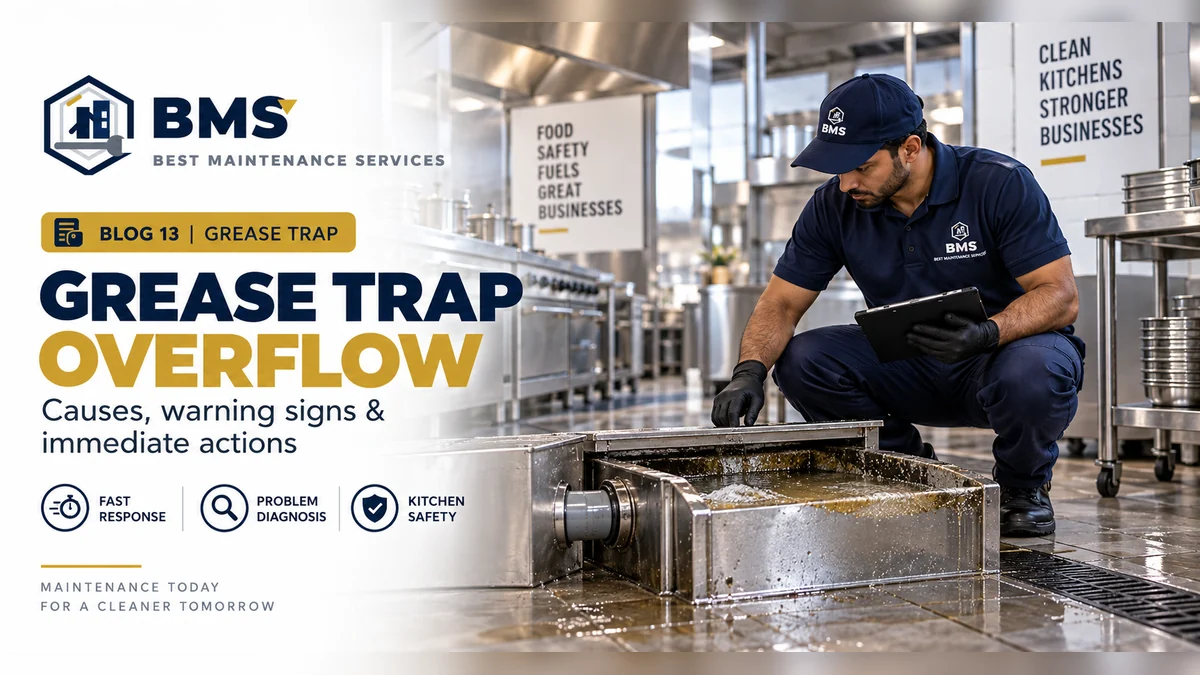
A grease trap overflow can stop kitchen operations and affect surrounding drains. Learn the warning signs, likely causes, safe immediate actions and what should be checked before reopening…
A grease trap overflow is not just an unpleasant maintenance issue. In a restaurant, café, hotel or production kitchen it can affect drainage, hygiene, staff movement and normal service. The quickest safe response is to reduce wastewater entering the affected system, contain the area and identify why the level is rising before normal use resumes.
The important diagnostic point is that an overflowing grease trap is not always simply “full.” Heavy FOG and solids can reduce working capacity, but the outlet may also be restricted, downstream drains may be blocked, internal components may be damaged or the unit may be too small for current kitchen demand. Treating every overflow as a routine clean-out can allow the same incident to return.
Early Warning Signs Before an Overflow
- Water draining more slowly from connected sinks.
- Gurgling or movement in the grease-trap inlet line.
- Persistent grease or wastewater odor near the unit.
- Unusually high liquid level during inspection.
- Grease visible near the outlet side of the unit.
- Frequent need for emergency cleaning before the planned service date.
- Nearby floor drains becoming slow or backing up during kitchen peak periods.
Immediate Actions for Kitchen Staff
If wastewater is rising toward the lid or escaping from the unit, reduce discharge immediately. Stop or limit use of connected sinks and equipment as operationally possible. Do not keep running hot water in the hope that it will “melt the grease away”; that can move FOG farther into the drainage system and increase the downstream problem.
Restrict access to affected surfaces, follow the kitchen’s cleaning and contamination-control procedures, and protect electrical equipment or stored items from wastewater. Do not open covers or attempt internal work unless staff are trained and the unit can be accessed safely.
Cause 1: The Trap Is Overloaded With FOG and Solids
As retained grease and solids occupy more internal volume, the unit has less effective working space. Flow can become restricted and separation performance can fall. If this condition repeatedly appears well before the planned service date, the maintenance interval may be too long for the current kitchen load.
Review food preparation practices, sink strainers and FOG disposal habits as well as the cleaning schedule. Maintenance is more reliable when grease is kept out of the drain at source rather than relying on the trap to accept unlimited loading.
Cause 2: Outlet or Downstream Drain Restriction
A trap can be relatively clean and still overflow when wastewater cannot leave efficiently. Grease, scale or debris in the outlet pipe or downstream drainage creates backpressure and raises the level inside the interceptor. This is why technicians should observe inlet and outlet behavior rather than stopping after removing retained grease.
Where downstream blockage is suspected, BMS can coordinate commercial drain cleaning and, where appropriate, further inspection. The existing guide on how FOG damages commercial drainage explains how grease can accumulate beyond the trap.
Cause 3: Incorrect Capacity or Changed Kitchen Demand
A unit that performed acceptably when the kitchen opened may become inadequate after menu changes, additional equipment, longer operating hours or increased production. Frequent overflow or very short cleaning intervals can be a signal that sizing should be reviewed rather than simply increasing emergency call-outs.
Sizing should consider fixture flow, peak use, grease load, installation constraints and maintenance access. A replacement decision should follow an assessment of the real operating pattern.
Cause 4: Internal Damage or Poor Installation
Cracked chambers, damaged baffles, poor inlet/outlet arrangements, badly sealed covers and incorrect pipe levels can affect performance. Some faults cause leakage; others reduce separation or create uneven flow. If the same problem returns immediately after proper cleaning, inspect the physical unit and connections.
For installation-related questions, use the BMS grease trap installation requirements guide as a starting point, then verify the actual site.
What a Technician Should Check After an Overflow
- Actual retained grease and solids level.
- Inlet flow and whether connected fixtures are discharging normally.
- Outlet flow and evidence of downstream restriction.
- Condition of lids, seals, internal components and chamber.
- Whether the unit appears suitable for current kitchen demand.
- Evidence that FOG has migrated into downstream drains.
- The previous maintenance interval and recent operating changes.
Do Not Reopen the System Based Only on a Lower Water Level
An overflow can temporarily subside when kitchen activity slows. That does not prove the cause has cleared. If a restriction remains, the level may rise again during the next service period. Confirm normal flow after cleaning or repair and observe the system under realistic use before treating the incident as closed.
Record what was found, what work was completed and what follow-up is required. A recurring overflow without a written history often leads to repeated emergency cleaning instead of root-cause correction.
Preventing the Next Grease Trap Overflow
- Keep FOG and food solids out of sinks as far as practical.
- Use and maintain appropriate sink strainers.
- Follow a documented service schedule based on actual accumulation.
- Keep covers and service access clear.
- Investigate slow downstream drainage before it becomes a backup.
- Review capacity when kitchen production changes.
- Maintain a service record with defects and next actions.
When Grease Trap Service and Drain Cleaning Are Both Needed
If the trap is heavily loaded and the downstream pipe is also coated with grease, the kitchen has two separate maintenance tasks. Cleaning the interceptor restores its working volume; cleaning the drain restores pipe capacity. The BMS guide Grease Trap vs Commercial Drain Cleaning explains the distinction.
For an active overflow, provide BMS with the property location, trap position, connected fixtures, photographs where safe, whether several drains are affected and the most recent service date. Those details help route the call toward cleaning, drainage work, repair or replacement rather than assuming one solution.
Site Information That Improves the Assessment
For grease trap overflow Dubai, a useful enquiry includes the exact kitchen location, business type, operating hours, photographs of the trap and connected sink area, the last known service date, and a short description of any overflow, odor or downstream blockage. If drawings, model information or previous service records exist, include them. These details help separate a capacity, installation, maintenance and drainage problem before unnecessary work is proposed.
For an operating kitchen, also explain when the problem is worst: during opening preparation, peak lunch or dinner service, pot washing, or after a particular sink is used. Timing can reveal whether the system is being overwhelmed by peak flow, whether one connection is creating the issue, or whether a downstream restriction is affecting several fixtures.
Commercial Kitchen Decision and Handover Standard
A professional result should be understandable after the technician leaves. The handover should identify what was inspected, what condition was found, what work was completed, any limits on the inspection, defects that remain, and the next recommended action. Where a new unit or modification is proposed, the customer should be able to see how the recommendation relates to current kitchen demand, available space and future maintenance access.
This record is especially important for landlords, facility managers and multi-site restaurant operators. It reduces repeated diagnosis, gives the next contractor useful history and helps management see whether the same failure is returning despite routine servicing.
Avoid Solving the Wrong Problem
Grease-trap faults and commercial drain faults often appear together. An interceptor can be maintained correctly while the outlet pipe remains grease-lined, or a drain can be cleaned while an undersized or damaged trap continues to overload it. The most cost-effective approach is to identify which part of the system is responsible before repeating the same service.
BMS keeps grease-trap sizing, supply, installation and replacement separate from drain cleaning and wider commercial-kitchen maintenance. That structure makes quotations clearer and gives customers a direct route to the service that actually owns the problem.
Questions to Confirm Before Approving the Work
Before approving work related to grease trap overflow Dubai, confirm the symptom or operational objective, what has already been tried, the exact scope included, any exclusions, the access or shutdown required, and how completion will be verified. This avoids a common maintenance problem where the customer and contractor use the same service name but expect different work.
For corrective work, ask what evidence supports the recommended action and what would change the recommendation. For planned maintenance, ask what condition will be checked at the next visit and how the interval should be adjusted if the system is loading faster or slower than expected. These questions turn the service from a one-off transaction into a controlled maintenance decision.
Property and Operations Context Matters
The same issue described in Grease Trap Overflow in a Commercial Kitchen: Causes, Warning Signs & Immediate Actions can have different consequences in a villa, apartment tower, restaurant, hotel or managed commercial site. Access permissions, occupied areas, service hours, equipment shutdown, noise, protection of finishes and coordination with building management can all affect the practical method even when the technical fault is similar.
Tell BMS about those constraints before attendance. A technically correct repair or cleaning method still needs to fit the property safely and with the least reasonable disruption. Where several trades are involved, each technical scope should remain separately documented even if the visit is coordinated.
Use the Result to Prevent Recurrence
After the immediate work is complete, record the root cause where it is known, the condition found, parts or areas serviced, and any prevention advice that is specific to the property. If the same symptom returns, compare it with the previous record instead of starting from assumptions.
Recurring maintenance records are valuable because they reflect real questions customers ask and help future service decisions. BMS can use anonymized recurring problem patterns, genuine project photographs and verified service experience to improve future guidance without inventing claims or copying generic advice.
Final approval should record the diagnosed condition, completed scope, verification result, responsible follow-up action and next review date so the maintenance history remains useful.
Need a quote or technical guidance?
Share your emirate, property or business type, relevant photos, site access details and preferred timing. BMS will confirm the appropriate next step.
Frequently Asked Questions
What should I do first if a grease trap is overflowing?
Reduce or stop wastewater discharge to the affected line, protect the surrounding area, keep staff away from contaminated surfaces and arrange professional assessment.
Does an overflowing grease trap always mean it is full?
No. It may be heavily loaded, but an outlet restriction, downstream blockage, damaged component, poor flow or incorrect installation can create similar symptoms.
Can drain cleaning be needed after the trap is cleaned?
Yes. If grease has accumulated downstream, cleaning the trap alone may not restore normal drainage.