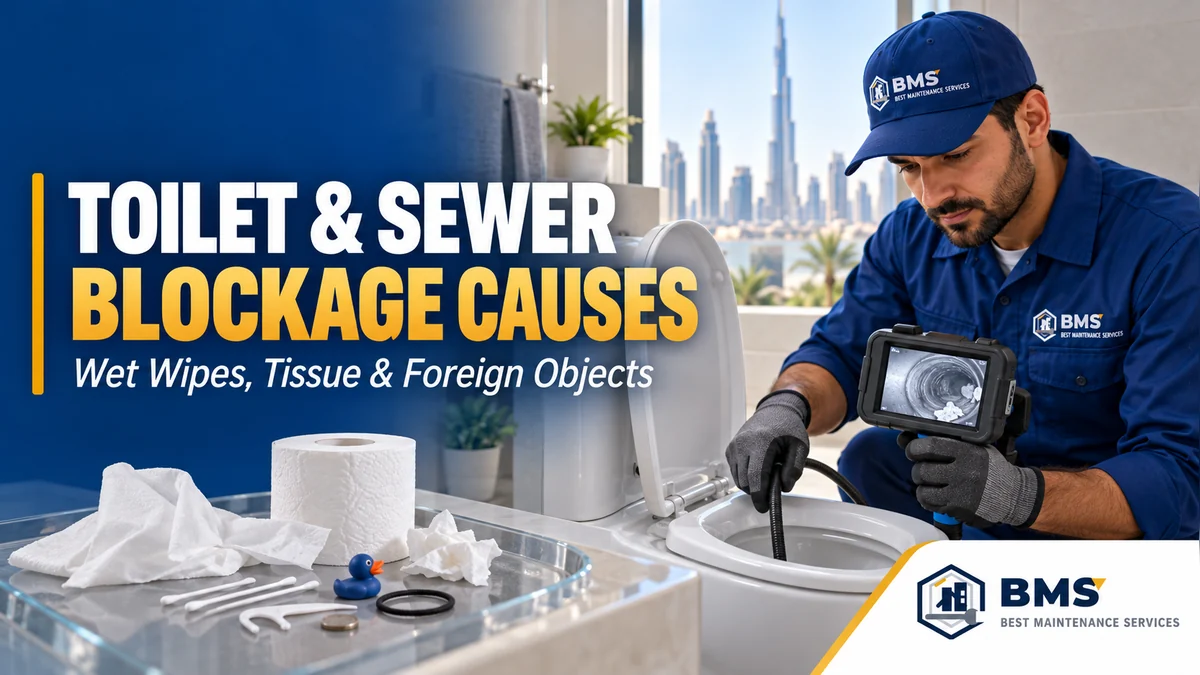
Wet wipes, sanitary products and foreign objects can create toilet and sewer blockages. Learn what should be flushed, warning signs and how professional clearing works.
Toilet paper is designed to break down in water relatively quickly. Wet wipes, sanitary products and many foreign objects are not. When these materials enter a toilet or drain, they can catch inside the trap, collect at joints, combine with grease or other debris and create a blockage that becomes denser over time.
This guide explains what should and should not go down a toilet, why “flushable” does not always mean trouble-free in a real drainage system, and when a blockage needs professional drain cleaning in Dubai.
Why toilet paper behaves differently
Normal toilet paper is manufactured to lose strength after it becomes wet. That allows it to move through properly functioning plumbing with normal flushing. Using excessive quantities at once can still contribute to a local blockage, especially in a restricted toilet or branch line, but the material itself is intended for this use.
Why wet wipes are more difficult
Wet wipes are designed to stay intact while they are used. That strength can remain after flushing. A wipe can fold, stretch and catch on rough surfaces or existing buildup. More wipes then collect around it, creating a larger obstruction. This is one reason a drain may appear to clear temporarily and then block again.
What about products labelled “flushable”?
A label does not guarantee that every drainage system will handle the product without problems. Real properties have different pipe diameters, gradients, bends, joints, existing buildup and flow conditions. From a preventive-maintenance perspective, putting wipes in a bin rather than the toilet removes that risk completely.
Sanitary products
Sanitary pads, tampons and similar products can expand or remain intact after entering the drain. They should be disposed of in a suitable bin, not flushed. In commercial washrooms, clear disposal facilities and simple signage can reduce repeated blockage callouts.
Paper towels, tissues and cleaning cloths
Facial tissues, paper towels and industrial wipes are not designed to disintegrate like toilet paper. Commercial cleaning cloths can be especially strong. Flushing them can create an obstruction in the toilet trap or further downstream.
Children's toys and household objects
Small toys, caps, packaging, air freshener components and cleaning items can accidentally enter a toilet. If a hard object is suspected, do not repeatedly force it deeper with improvised rods. Tell the technician what may have fallen in so the clearing method can be selected appropriately.
Food, grease and kitchen waste do not belong in toilets either
Using the WC as a general waste route introduces materials that the drainage system was not designed to receive. Grease can cool and adhere to pipework, while food and packaging can combine with wipes or paper to create a larger blockage.
How wipes create deeper sewer blockages
A wipe that passes the toilet can still become a problem further along the line. It may catch on scale, a displaced joint, roots or another obstruction. Additional waste then accumulates around that point. This can turn a small pipe imperfection into a recurring main-line blockage.
Signs the blockage is still local to the toilet
- The bowl rises or drains slowly after flushing.
- Only one toilet is affected.
- Nearby sinks, showers and floor drains remain normal.
- The problem began immediately after a known item was flushed.
Stop using the toilet and avoid repeated flushing when the bowl is already high.
Signs wipes or debris may be affecting a deeper line
If several toilets or drains become slow together, wastewater returns through floor drains, or the blockage keeps coming back after local clearing, the restriction may be downstream from the fixture. Our guide to local blockage versus main sewer symptoms explains the pattern.
Why strong chemical cleaners do not solve a wipe blockage
Chemicals do not reliably dissolve wipes, sanitary products or solid objects. If the liquid remains trapped behind a blockage, it can also create a hazard when the system is later opened mechanically. A physical obstruction needs a method that removes or clears the actual material.
Professional methods for removing wipe and object blockages
The correct tool depends on where the obstruction sits. A local toilet blockage may be approached at the fixture. A deeper branch or sewer blockage can require mechanical cleaning. If the obstruction repeatedly returns or structural damage is suspected, CCTV inspection can identify what is catching the material.
When hydro jetting helps—and when it does not
Hydro jetting can remove adhered buildup from suitable drainage lines, but it is not automatically the right method for a hard foreign object lodged inside a toilet. The technician should identify the blockage type and pipe route first. BMS compares snaking, mechanical cleaning, hydro jetting and CCTV in its drain-cleaning methods guide.
Commercial washrooms need prevention systems
Restaurants, offices, schools, gyms and other high-traffic properties can reduce blockages through practical waste-management design. Provide bins inside cubicles, keep them serviced, use clear polite signage and make sure cleaning teams understand that wipes and paper towels should not enter toilets or floor drains.
What to do after a wipe-related blockage is cleared
If the blockage was a one-time event and flow returns fully, prevention may be enough. If it has happened repeatedly, ask whether the line should be inspected for an underlying restriction. Repeatedly catching wipes at the same location can indicate rough or damaged pipework rather than only user behaviour.
How to prevent toilet and sewer blockages
- Flush only toilet waste and normal toilet paper.
- Place wet wipes and sanitary products in a bin.
- Keep toys and small bathroom items away from open toilets.
- Do not use the toilet for food, grease or general waste.
- Investigate repeated slow flushing or gurgling before a full backup occurs.
Why repeated wipe blockages can reveal an underlying pipe problem
If the same property experiences repeated wipe-related blockages despite improved disposal habits, the line may have a rough joint, scale buildup, poor gradient or structural defect that catches material. In that case, blaming user behaviour alone misses the maintenance issue. CCTV inspection can show whether the pipe itself is contributing to recurrence.
Toilet paper quantity still matters
Toilet paper is designed to break down, but very large quantities flushed at once can still overwhelm a restricted toilet trap or branch. If a toilet only blocks under heavy paper loads, the system may already have reduced capacity. Repeatedly telling users to use less paper without checking the drainage condition can hide an underlying restriction.
What facility managers should do after repeated washroom blockages
Record which cubicle or drain is affected, what material was found, whether the blockage was local or deeper, and how soon it returned. Provide suitable bins and clear disposal guidance, but also review the drainage route if the same location fails repeatedly. A pattern across several washrooms can indicate a shared branch problem rather than isolated misuse.
How to explain the issue to customers or tenants
Use simple, non-accusatory guidance: only toilet paper and normal toilet waste should be flushed; wipes, paper towels and sanitary products belong in the bin. In commercial properties, place disposal bins where they are convenient to use. Prevention works better when the correct disposal option is obvious.
What to tell the drainage technician
If you know a specific item was flushed, say so. Explain whether the toilet is completely blocked or only slow, whether another fixture reacts, and whether the problem has happened before. This can determine whether the technician begins with local retrieval, mechanical clearing or a deeper branch/sewer assessment.
Why bins and signage are a maintenance control, not just housekeeping
In busy washrooms, users need an easy alternative to flushing unsuitable products. A covered bin inside each cubicle, regular waste collection and clear signage reduce the amount of wipes and sanitary waste entering the drainage system. Facilities teams should treat these measures as part of blockage prevention, especially where recurring callouts have already occurred.
Household rule: If an item does not break down like normal toilet paper, put it in the bin rather than testing whether the toilet can carry it. That simple rule prevents many avoidable WC and sewer blockages.
For families, explain the rule to children and domestic staff as well. Consistent disposal habits across everyone using the property are more effective than correcting the problem after each blockage.
These habits are simple, inexpensive and highly effective.
Consistency prevents repeat problems.
When to call BMS
Request BMS drain cleaning when a toilet remains blocked, the bowl repeatedly rises, several fixtures are affected, a known object was flushed, or the problem keeps returning after clearing. Share what may have entered the drain and whether other fixtures are involved. This helps the technician choose the safest and most effective toilet or sewer cleaning method.
Need a quote or technical guidance?
Share your emirate, property or business type, relevant photos, site access details and preferred timing. BMS will confirm the appropriate next step.
Frequently Asked Questions
Are flushable wipes safe for every toilet?
No. Real drainage systems vary, and wipes can remain intact long enough to catch on buildup or pipe defects.
What should normally be flushed?
Normal toilet waste and appropriate toilet paper are the safest materials intended for WC disposal.
Can a foreign object cause a main sewer blockage?
Yes. An object can lodge locally or travel further and collect other debris, especially where the pipe already has a restriction.