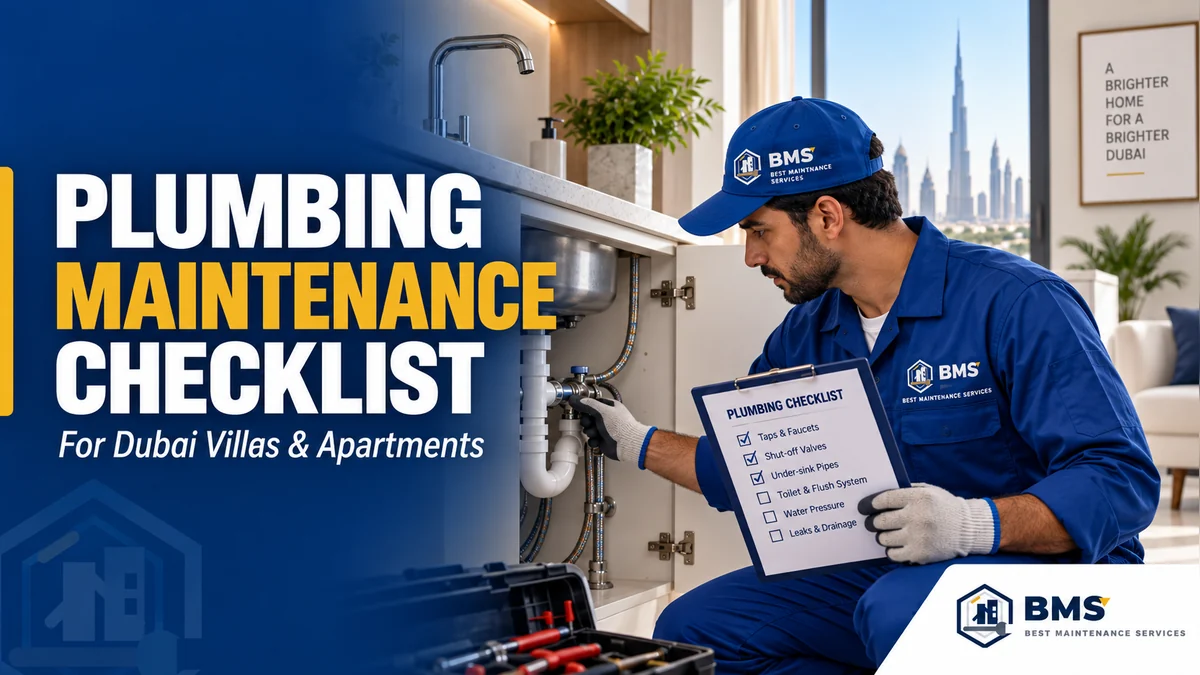
Use this practical plumbing maintenance checklist to inspect taps, toilets, visible pipes, drains, isolation valves and warning signs in Dubai villas and apartments before small problems…
Plumbing maintenance is most useful when it finds small, visible warning signs before they become disruptive leaks, blockages or fixture failures. You do not need to dismantle the plumbing system every month. A structured check of taps, toilets, exposed connections, drains and isolation points can reveal a surprising amount about the condition of a Dubai villa or apartment.
This checklist is designed for homeowners, tenants, landlords and property managers. It does not replace professional inspection where there is evidence of a fault. For repairs and diagnosis, BMS provides plumbing services across Dubai.
Monthly quick plumbing check
A short monthly walk-through can focus on changes rather than technical testing. Look for anything new: moisture, staining, unusual noise, weaker flow, slow drainage or a fixture that no longer operates as it did.
- Open sink cabinets and check for dampness.
- Look around toilets for water or movement at connections.
- Check taps and mixers for drips after shutoff.
- Notice whether showers and taps have normal, consistent flow.
- Watch whether sinks, showers and floor drains empty normally.
- Listen for toilets that continue filling after flushing.
- Look at visible flexible hoses and valves for corrosion or moisture.
Kitchen plumbing checklist
Under the sink
Remove enough stored items to see the connections. Look at mixer hoses, local valves, the waste trap and any appliance connections. A slow leak may leave only a small stain or swollen cabinet edge at first.
Mixer operation
Check that the mixer moves normally, shuts off completely and has consistent flow. Water at the base of the tap should be investigated rather than repeatedly wiped away.
Drain flow
The sink should drain without prolonged standing water or repeated gurgling. Grease and food residue are common contributors to kitchen drain restrictions. If slow drainage returns repeatedly, see our kitchen drain cleaning guide.
Bathroom plumbing checklist
- Check basin and shower mixers for drips and stable flow.
- Look below accessible basins for moisture.
- Flush toilets and confirm the cistern stops filling normally.
- Watch for movement or leakage around the toilet base and supply connection.
- Confirm showers and floor drains clear water without persistent pooling.
- Look for new stains on ceilings or walls near wet areas.
Bathrooms contain both pressurized supply plumbing and wastewater drainage. A leak and a blockage can therefore create very different symptoms even when they occur in the same room.
Check water pressure for changes
You do not need specialist equipment to notice a major change in normal fixture performance. If several outlets become noticeably weaker, note whether the problem affects hot water, cold water or both, and whether the change is limited to one room or the whole property.
Sudden pressure changes combined with dampness or water sound should be investigated. Gradual weakness at one fixture may be a local restriction instead.
Know where the important isolation valves are
During a leak, knowing how the affected fixture or property supply is isolated can reduce damage. Property arrangements vary, particularly between villas and managed apartment buildings, so identify the correct valves before an emergency rather than during one.
Do not force a seized or corroded valve. If an isolation valve is difficult to operate or already leaking, include it in the maintenance list.
Flexible hoses and visible connections
Flexible connectors are used at many taps, toilets and appliances. Inspect visible hoses for moisture, damage, severe corrosion at fittings, unusual deformation or signs of previous leakage. A hose that looks questionable should be assessed before it fails under pressure.
Toilets: check more than the bowl
A toilet can waste water without leaking onto the floor. After flushing, listen for whether the cistern eventually becomes quiet. Continuous hissing, water movement in the bowl or repeated refill cycles can indicate a cistern fault.
External moisture near the toilet requires separate investigation because the source may be the supply connection, local valve, cistern, seal or another nearby plumbing point.
Drainage maintenance: prevent what you can
Good drain maintenance starts with what goes into the system. Keep cooking fats and food residue out of kitchen drains, use suitable strainers where appropriate, and avoid flushing wipes or foreign objects through toilets. Preventive habits reduce avoidable buildup but do not remove an established deep blockage.
If drains are repeatedly slow, smell, gurgle or back up, the right response is diagnosis and professional drain cleaning, not simply adding stronger chemicals.
Look for hidden-leak clues
Some plumbing leaks are not visible at the pipe. Warning signs can include new wall or ceiling stains, swelling cabinetry, persistent dampness, paint deterioration, unexplained moisture near wet areas or water sound when fixtures are not being used.
One sign alone does not identify the source. Where evidence suggests a concealed supply leak, targeted inspection is more useful than opening finishes without a plan.
Quarterly or seasonal deeper check
Every few months, or before a property is left unused for an extended period, make the inspection more deliberate:
- Check all accessible sink cabinets rather than only the most-used one.
- Operate less frequently used taps and fixtures.
- Observe every toilet through a full flush-and-refill cycle.
- Check visible valves and hoses for condition changes.
- Compare drainage speed in showers and floor drains.
- Review any previous leak area for recurring moisture.
- Confirm maintenance or building-management contacts are current.
Villa-specific plumbing considerations
Villas can have wider pipe runs, external service areas, tanks, pumps or additional outdoor fixtures depending on the property. The plumbing maintenance plan should reflect the systems actually installed. Outdoor hose points, irrigation-related connections and service rooms can be overlooked when inspections focus only on kitchens and bathrooms.
Our existing villa maintenance guide covers the broader property-maintenance context beyond plumbing.
Apartment-specific plumbing considerations
In an apartment, some water and drainage systems are shared or controlled by the building. If several units experience the same pressure or drainage problem, building management may need to be involved. Inside the apartment, however, fixture hoses, valves, mixers, toilets and local connections still need routine attention.
After any plumbing repair
Do not treat “water stopped” as the only acceptance check. After a repair, confirm that the fixture operates normally, the repaired area remains dry under use, isolation valves are left in the correct condition, cabinets are dried, and any affected finishes are monitored for residual moisture.
Keep a simple property maintenance record
For landlords and facility teams, record the date, location, symptom, repair and any recommended follow-up. Repeated faults at the same fixture or pipe route become easier to identify when there is a history. This also helps distinguish a one-off repair from a component or system that is approaching replacement.
When should maintenance become a professional inspection?
Arrange professional support when you find recurring leaks, weak pressure affecting multiple outlets, repeated drain blockages, difficult or leaking valves, concealed moisture, corrosion, failing toilet mechanisms or a problem that has already returned after repair. Preventive maintenance is valuable because it directs attention early; it is not a reason to postpone a known fault.
| Check | Normal observation | Action signal |
|---|---|---|
| Taps/mixers | Shut off fully, stable flow | Drips, base leaks, weak or erratic flow |
| Toilets | Refill then stop | Continuous running, external moisture |
| Under sinks | Dry cabinet and connections | Dampness, staining, swelling |
| Drains | Clear flow | Slow drainage, gurgling, backup, odor |
| Valves/hoses | Dry and sound | Leaks, corrosion, damage, seizure |
BMS plumbing maintenance support
BMS has completed 600+ plumbing service jobs with 98%+ reported customer satisfaction based on the supplied plumbing-service statistics. If your checklist reveals a leak, fixture fault, pressure issue or plumbing concern, request service through the BMS plumbing page and provide the property location, affected fixture and visible symptoms.
Prioritize checks by risk, not by convenience
Not every plumbing item carries the same consequence. Flexible hoses, isolation valves, concealed leaks and continuously running toilets deserve early attention because failure can waste significant water or damage finishes. A slow drain is important too, but it usually gives different warning signs. A useful maintenance routine therefore separates water-supply risks, fixture faults and drainage symptoms rather than treating plumbing as one generic checklist.
Document changes from one inspection to the next
A simple record makes maintenance more useful. Note the date, affected room, symptom and action taken. If water pressure gradually changes, a stain grows, a hose begins to corrode or a toilet starts refilling more often, the history can help a technician understand whether the condition is stable or progressing. For landlords and managed properties, records also help explain what was inspected between tenancies or maintenance visits.
Coordinate plumbing with other property maintenance
Plumbing inspections are often more effective when timed with access already planned for AC servicing, kitchen maintenance or renovation work. For example, cabinets opened during kitchen work provide an opportunity to inspect valves and supply lines, while bathroom renovation is the right time to review concealed connections before finishes are closed. Coordination can reduce repeat access and gives the property owner a clearer picture of upcoming maintenance needs.
When preventive maintenance should become diagnostic work
A checklist is not a substitute for diagnosis. Escalate the issue when you find repeated dampness, unexplained pressure loss, continuous toilet refilling, recurring blockages, corrosion around connections or water marks with no visible source. Those symptoms need fault-finding rather than another routine check. BMS can route the request to plumbing, drain cleaning or another relevant maintenance service based on the actual condition.
Prepare for a professional inspection
Before the visit, make sure technicians can reach under-sink cabinets, toilet access panels, water heaters where applicable and known isolation points. Share any recent repair history and identify rooms where pressure, drainage or leaks have changed. Good access and clear information reduce unnecessary diagnosis time and help the technician verify the repair or maintenance recommendation more efficiently.
Service preparation note
For a more efficient visit, provide the exact Dubai location, property type, affected fixture, when the symptom began and any photos that show the problem clearly. Do not dismantle concealed plumbing or force seized valves simply to create access. The objective is to give the technician enough information to arrive prepared while keeping the installation safe for proper diagnosis.
Create a simple annual plumbing review
In addition to monthly visual checks, schedule a broader review of recurring issues once a year or before a major occupancy change. Look back at leak repairs, toilet faults, pressure complaints and drain blockages to identify patterns. Repeated problems in the same zone may point to an underlying condition that deserves diagnosis rather than another isolated repair. This is especially useful for landlords, villa owners and facilities teams managing several rooms or properties.
Do not ignore “small” changes
A mixer that becomes harder to operate, a toilet that refills slightly longer, a valve with early corrosion or a drain that is gradually slowing can provide useful warning before failure. Maintenance is most valuable when it catches those changes early and routes them to the correct service before they become an emergency.
Need a quote or technical guidance?
Share your emirate, property or business type, relevant photos, site access details and preferred timing. BMS will confirm the appropriate next step.
Frequently Asked Questions
How often should I inspect plumbing in a Dubai home?
A simple visual check can be done regularly, while the right professional inspection frequency depends on property age, system condition, previous leaks and how heavily the property is used.
What plumbing areas should tenants check most often?
Visible areas under sinks, around toilets, at mixers, flexible hoses and accessible valves are useful places to look for moisture, corrosion or slow leaks.
Should drains be chemically cleaned as preventive maintenance?
Routine chemical use is not a substitute for diagnosis and can be unsuitable for some systems. Preventive care should focus on what enters the drain and on professional cleaning when flow or buildup indicates it is needed.
What should I do before leaving a villa empty for a long period?
Check for existing leaks, know how the property water supply is controlled, confirm appropriate arrangements with property management or maintenance staff, and avoid leaving known plumbing faults unresolved.